


Bleu de Méthylène : Utilisations Thérapeutiques et Signification Clinique
Le Bleu de méthylène est un puissant antioxydant synthétique. Il améliore la fonction mitochondriale et la capacité de nos cellules à produire de l'énergie.
Milos Pokimica
Écrit par : Milos Pokimica
Examiné Médicalement Par : Dr. Xiùying Wáng, M.D.
Mise à jour le 4 janvier 2024Principaux Enseignements :
- Le bleu de méthylène est un antioxydant soluble dans l'eau et dans l'huile, capable de traverser la barrière hémato-encéphalique.
- Le bleu de méthylène est un puissant antioxydant qui peut protéger les mitochondries du stress oxydatif. Il peut également améliorer la fonction des mitochondries en augmentant leur consommation d'oxygène et leur production d'ATP.
- Le bleu de méthylène peut contourner certaines étapes de la chaîne de transport d'électrons mitochondriale, qui est une série de transporteurs d'électrons qui font passer les électrons du NADH et du FADH2 à l'oxygène. Le bleu de méthylène peut ainsi réduire la production de radicaux libres et augmenter la production d'ATP.
- En augmentant à la fois la chaîne de transport d'électrons et le métabolisme du glucose, le bleu de méthylène peut augmenter la quantité d'ATP produite par les cellules cérébrales. Cela signifie plus d'énergie pour une meilleure fonction cérébrale, y compris la cognition, l'humeur et la mémoire.
- Le bleu de méthylène peut également protéger les cellules cérébrales du stress oxydatif et du vieillissement, qui peuvent nuire à leur production d'énergie et à leur fonction.
- Il a été démontré que le bleu de méthylène a des effets bénéfiques sur diverses maladies et troubles cérébraux, tels que la maladie d'Alzheimer et la maladie de Parkinson, qu'il aide à soigner les lésions cérébrales et qu'il peut également aider à lutter contre le vieillissement normal du cerveau, qui peut entraîner une perte de mémoire et un déclin cognitif.
- Le bleu de méthylène peut stimuler la production de collagène et d'élastine dans la matrice extracellulaire. En outre, le bleu de méthylène peut absorber les rayons UV et prévenir les lésions de l'ADN causées par l'irradiation UVB dans les kératinocytes humains.
- Le bleu de méthylène peut faciliter la migration et la prolifération des fibroblastes dans le processus de cicatrisation.
- Le bleu de méthylène peut augmenter les niveaux de norépinéphrine, de sérotonine et de dopamine dans le cerveau en inhibant les enzymes qui décomposent ces neurotransmetteurs. (Alda, 2019).
- Le bleu de méthylène inhibe l'activité de la monoamine oxydase et de l'acétylcholinestérase, augmentant ainsi les taux de catécholamines et d'acétylcholine.
- Le bleu de méthylène améliore de manière significative les symptômes de la dépression, de la manie, de l'anxiété et du fonctionnement cognitif.
- Plusieurs études ont montré que la MB peut améliorer la mémoire dans différents types de tâches d'apprentissage et dans différentes populations.
- Le bleu de méthylène peut empêcher la protéine Tau de former des fibrilles en modifiant sa structure chimique (Crowe et al, 2013). Il fait actuellement l'objet d'essais cliniques en tant que nouveau traitement de la maladie d'Alzheimer.
- Le bleu de méthylène peut protéger les fonctions motrices et non motrices dans la maladie de Parkinson en améliorant la fonction mitochondriale et en réduisant le stress oxydatif.
- Le bleu de méthylène est un nootropique qui peut vous aider à mieux apprendre, à vous souvenir davantage, à vous sentir plus heureux, à être plus performant et à dormir plus profondément.
- En laboratoire, le bleu de méthylène a tué efficacement les bactéries de Lyme résistantes aux antibiotiques (Feng et al, 2015).
- Des études ont également montré que la combinaison du bleu de méthylène avec des antibiotiques est plus efficace que les antibiotiques seuls pour traiter d'autres types d'infections à Bartonella (Zheng et al, 2020).
- Le bleu de méthylène peut tuer Plasmodium falciparum, le type de paludisme le plus dangereux, lors de tests en laboratoire, sur des souris et des singes. Il peut également vaincre la résistance que certaines souches de P. falciparum et de P. vivax ont développée à l'égard d'autres antipaludiques.
- Le bleu de méthylène aide à lutter contre les infections fongiques de la même manière qu'il aide à lutter contre les infections bactériennes.
- Le bleu de méthylène cible trois aspects principaux du Candida albicans : ses mitochondries, son cycle d'oxydoréduction et sa membrane. Il empêche le Candida albicans de se transformer en hyphes et le maintient dans sa forme de levure, moins dangereuse.
Qu'est-ce que le bleu de méthylène ?
Le bleu de méthylène est un sel synthétique utilisé comme colorant et comme médicament. Le bleu de méthylène existe depuis plus d'un siècle. Il s'agit du premier médicament synthétique jamais fabriqué par l'homme, appelé "premier médicament entièrement fabriqué par l'homme".
Il a une longue histoire d'applications médicales et de recherche. Il est également connu pour sa capacité à colorer en bleu les tissus et les liquides, ce qui peut être utile à des fins de diagnostic. C'est l'un des plus anciens colorants synthétiques et l'un des nootropiques les plus prometteurs.
Le bleu de méthylène a été synthétisé pour la première fois en 1876 par un chimiste allemand nommé Heinrich Caro, qui travaillait pour la société de teintures BASF (Ig Farben). Il l'a nommé chlorure de méthylthionine, mais il a rapidement été connu sous le nom de bleu de méthylène en raison de sa couleur bleue et de sa capacité à former des groupes méthylènes lorsqu'il est réduit.
À l'origine, il était utilisé comme antiseptique et comme traitement de la malaria. C'est l'un des premiers colorants synthétiques utilisés en médecine. Il a été utilisé pour la première fois en 1891 par le médecin suisse Paul Ehrlich, qui l'a injecté à des souris infectées par le charbon et a observé qu'il colorait les bactéries mais pas les cellules saines. Il l'a également utilisé pour colorer au microscope des cellules sanguines et des parasites de la malaria.
Le bleu de méthylène a également été l'un des premiers médicaments utilisés pour traiter le paludisme. Il a été découvert en 1891 par les chimistes français Othmar Zeidler et Alphonse Laveran, qui ont constaté qu'il tuait le parasite du paludisme in vitro. Ils l'ont également testé sur des patients humains et ont constaté qu'il les guérissait des symptômes du paludisme. Depuis lors, il a été étudié pour ses effets sur diverses maladies et troubles, tels que la maladie d'Alzheimer, la dépression, la schizophrénie et l'empoisonnement au cyanure.
La principale propriété du bleu de méthylène pour la santé est qu'il s'agit d'un antioxydant soluble dans l'eau et dans l'huile, capable de traverser la barrière cutanée. barrière hémato-encéphalique avec de nombreux avantages potentiels pour la santé antioxydants en tant que substance en général.
En tant que antioxydantIl peut protéger les cellules contre le stress oxydatif et les dommages causés par les radicaux libres et favoriser la réparation des lésions de l'ADN. Il présente des propriétés antioxydantes, antipaludiques, antiseptiques, antidépressives, cardioprotectrices et antivieillissement. Le bleu de méthylène peut augmenter Production d'ATP et la consommation d'oxygène dans les mitochondriesqui sont les usines énergétiques des cellules. Il peut également améliorer la formation de la mémoire et la mémorisation en renforçant le fonctionnement des cellules nerveuses du cerveau.
Produit de soin de la peau qui peut réduire les signes du vieillissement, tels que les rides, le relâchement et la pigmentation, en stimulant la synthèse du collagène et en réparant les dommages causés à l'ADN dans les cellules de la peau.
Il est également connu sous les noms d'Urelene blue, Provayblue et Proveblue. Ce sont quelques-uns des noms de marque des injections de bleu de méthylène qui sont utilisées pour traiter la méthémoglobinémie, une condition dans laquelle le sang ne peut pas transporter suffisamment d'oxygène en raison de l'oxydation de l'hémoglobine.
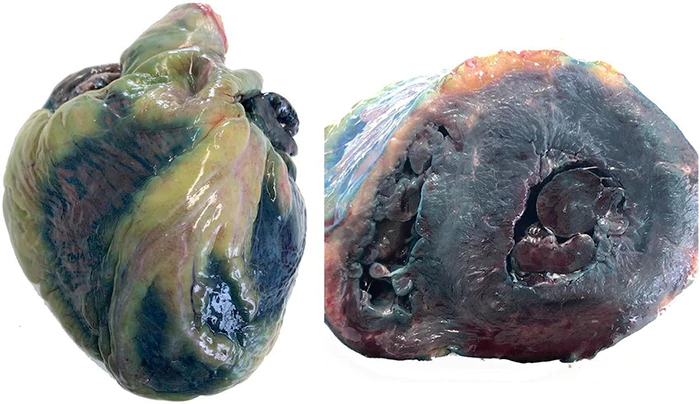
Résumé:
Le bleu de méthylène est un composé polyvalent à l'histoire longue, utilisé à l'origine comme colorant et antiseptique, mais qui se révèle aujourd'hui prometteur en tant qu'antioxydant et nootropique, avec des bénéfices potentiels pour la santé du cerveau, la réparation de l'ADN et même les soins de la peau.
Bleu de méthylène pour la consommation humaine.
Jusqu'à présent, le bleu de méthylène n'est pas approuvé par la FDA pour la consommation humaine en tant que complément alimentaire
Il est uniquement utilisé comme médicament pour traiter certaines affections, telles que la méthémoglobinémie, l'empoisonnement au cyanure et les infections des voies urinaires. Il s'agit d'un produit sûr et bien étudié, mais la FDA insiste toujours sur le fait qu'il ne doit être utilisé que sous la supervision d'un médecin ou d'un professionnel de la santé.
En tant qu'antioxydant, il est l'un des plus puissants qui existent, mais ce sont ses propriétés uniques qui nous intéressent si nous voulons l'utiliser en tant que supplément.
L'un des effets secondaires connus de ce médicament est qu'il ne doit pas être pris en même temps que certains médicaments, herbes ou compléments qui peuvent affecter le système immunitaire. sérotonine dans le cerveau. Dans le cas où nous voulons l'utiliser, le niveau de médicaments devra être considérablement réduit, voire complètement supprimé. Il s'agit notamment des antidépresseurs, des médicaments contre l'anxiété, du millepertuis, du tryptophane et d'autres encore. Il a de puissants effets nootropiques, antidépresseurs et anti-bipolaires et, contrairement aux antidépresseurs et aux médicaments contre l'anxiété, il a des effets secondaires beaucoup moins graves.
C'est l'un des suppléments qui n'est pas reconnu comme tel par la FDA car, à mon avis, il fonctionne réellement, vous n'avez pas besoin d'ordonnance (des ordonnances sont nécessaires pour les injections), il est beaucoup moins toxique que les médicaments antidépresseurs puissants et il est très bon marché.
Il s'agit essentiellement d'un colorant industriel qui s'est avéré être l'un des antioxydants les plus puissants pouvant être utilisés en médecine, à côté d'autres antioxydants. Des études récentes suggèrent que le bleu de méthylène, à faible dose, peut agir comme un puissant antioxydant et améliorer la fonction mitochondriale et la capacité de nos cellules à produire de l'énergie. C'est pourquoi de nombreuses personnes l'utilisent comme supplément nootropique pour stimuler le cerveau.
Résumé:
While a powerful antioxidant and nootropic with research-backed benefits, methylene blue remains unapproved by the FDA for dietary supplement use. Its strong nature necessitates a doctor’s supervision and caution when interacting with medicines affecting serotonin levels.
Le bleu de méthylène en médecine.
Les principales utilisations du bleu de méthylène en médecine sont les suivantes :
- Il est utilisé pour traiter la méthémoglobinémie, un état dans lequel le sang ne peut pas transporter suffisamment d'oxygène en raison de l'oxydation de l'hémoglobine. En tant qu'antioxydant puissant, il a la capacité de réduire la méthémoglobine en hémoglobine en donnant des électrons.
- Il peut également servir d'antidote en cas d'empoisonnement au cyanure, car il peut augmenter la respiration cellulaire en agissant comme un accepteur d'électrons alternatif dans la chaîne de transport d'électrons mitochondriale.
- Il est utilisé comme colorant pour la coloration de spécimens biologiques, tels que les cellules sanguines, les bactéries, les champignons, les parasites et l'ADN. Le bleu de méthylène peut améliorer le contraste et la visibilité de ces structures au microscope. Il peut également passer du bleu à l'incolore lorsqu'il est réduit par certains agents, ce qui en fait un indicateur d'oxydoréduction utile.
- Il est utilisé comme antidépresseur pour traiter les troubles bipolaires et les troubles dépressifs majeurs, car il peut moduler l'activité des neurotransmetteurs et des enzymes dans le cerveau.
- Il est utilisé comme produit de soin de la peau pour réduire les signes du vieillissement, tels que les rides, le relâchement et la pigmentation, en stimulant la synthèse du collagène (l'une des rares substances existantes à pouvoir réellement le faire) et en réparant les dommages causés à l'ADN dans les cellules de la peau. En raison de l'augmentation de la synthèse du collagène, il pourrait probablement aider à résoudre d'autres problèmes liés au collagène et à la guérison en dehors de la peau et des rides, mais nous n'en savons rien car la science est encore à la traîne dans ce domaine de recherche.
Résumé:
While primarily used to treat methemoglobinemia, methylene blue’s diverse applications include cyanide poisoning antidote, medical dye, antidepressant, and collagen synthesis stimulation. Its powerful antioxidant and electron-donating properties make it a valuable tool in various medical fields.
Le bleu de méthylène comme médicament anti-âge.
Le bleu de méthylène peut ralentir le processus de vieillissement et améliorer la santé et l'apparence.
Le vieillissement est un phénomène complexe qui implique de nombreux facteurs, mais l'un des principaux responsables est le stress oxydatif. Selon la "théorie du vieillissement par les radicaux libres"Le vieillissement des cellules et des tissus est le résultat des attaques des radicaux libres. Dans les cellules humaines, les espèces réactives de l'oxygène (ROS) sont principalement produits dans les mitochondries. Le stress oxydatif est le dommage causé par les radicaux libres, des molécules instables qui peuvent endommager les cellules et l'ADN. Les radicaux libres sont produits par des processus métaboliques normaux, mais ils peuvent également être déclenchés par des facteurs environnementaux, tels que pollutionLe stress oxydatif peut être causé par la pollution atmosphérique, les radiations et le tabagisme. Au fil du temps, le stress oxydatif peut entraîner diverses maladies et troubles, tels que cancer, le diabèteLa maladie d'Alzheimer, la maladie de Parkinson et l'arthrite.
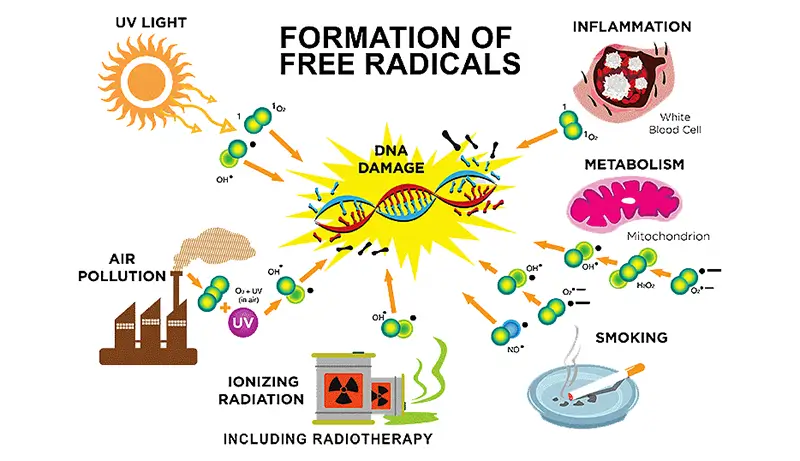
L'une des cellules les plus touchées par le stress oxydatif est la mitochondrie. Les mitochondries sont les centrales électriques des cellules, où l'énergie est produite à partir de la nourriture et de l'oxygène. Cependant, les mitochondries génèrent également des radicaux libres en tant que sous-produits de leur activité. Lorsque les mitochondries deviennent dysfonctionnelles, elles produisent moins d'énergie et plus de radicaux libres, créant un cercle vicieux de dommages et de déclin. Ce phénomène affecte de nombreux tissus de l'organisme, en particulier le cerveau et la peau, qui dépendent fortement de l'énergie et de l'oxygène.
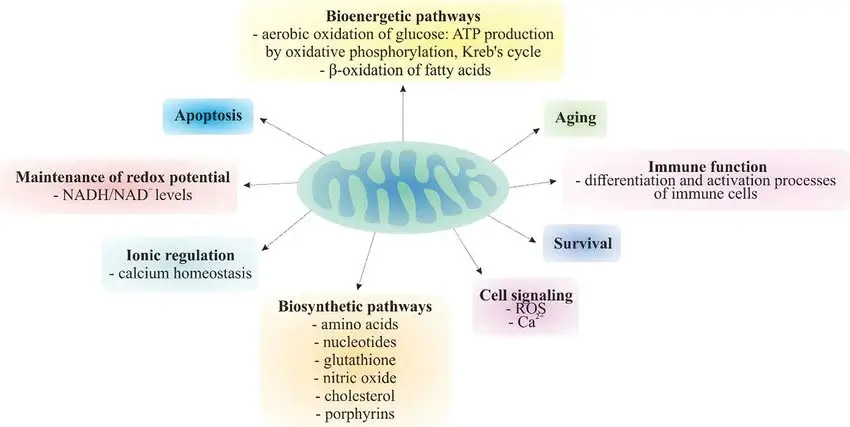
C'est là que le bleu de méthylène entre en jeu. Le bleu de méthylène est un puissant antioxydant qui peut protéger les mitochondries du stress oxydatif. Il peut également améliorer la fonction des mitochondries en augmentant leur consommation d'oxygène et leur production d'ATP. L'ATP est la molécule qui stocke et transporte l'énergie dans les cellules. En stimulant les performances des mitochondries, le bleu de méthylène peut améliorer le métabolisme cellulaire et réduire les signes du vieillissement.
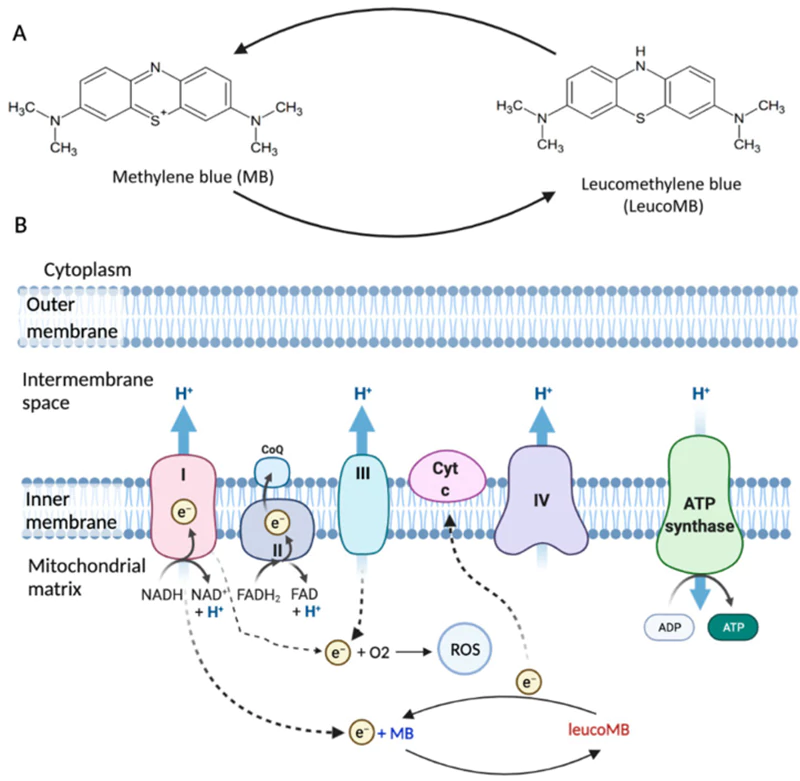
Le bleu de méthylène est un composé bleu qui peut changer de couleur et de charge en gagnant ou en perdant des électrons. Il peut être réduit en bleu de leuco-méthylène, qui est un composé incolore et neutre. Le bleu de méthylène peut facilement traverser les membranes cellulaires car c'est un antioxydant à la fois hydrosoluble et liposoluble. Il s'agit d'une propriété très rare que seuls quelques antioxydants possèdent. Un autre antioxydant universel, c'est-à-dire à la fois soluble dans l'eau et dans l'huile, est le astaxanthine.
Le bleu de méthylène a également une faible potentiel d'oxydoréductionce qui signifie qu'il peut facilement donner ou accepter des électrons. Ces caractéristiques font du bleu de méthylène un candidat idéal pour jouer le rôle de catalyseur d'oxydoréduction dans les mitochondries.
Le bleu de méthylène fonctionne comme un cycle redox catalytique dans la mitochondrie, ce qui signifie qu'il peut passer de sa forme oxydée à sa forme réduite en transférant des électrons. Le bleu de méthylène peut recevoir des électrons de NADHLe bleu de méthylène est une molécule qui transporte les électrons de la nourriture vers les mitochondries. Le bleu de méthylène peut alors transférer ces électrons au cytochrome c, une molécule qui transporte les électrons des mitochondries vers l'oxygène.
Ce faisant, le bleu de méthylène peut contourner certaines étapes de la chaîne de transport d'électrons mitochondriale, qui est une série de transporteurs d'électrons qui font passer les électrons du NADH et du FADH2 à l'oxygène. Le bleu de méthylène peut ainsi réduire la production de radicaux libres et augmenter la production d'ATP.
Résumé:
Methylene blue’s potent antioxidant and mitochondrial-boosting properties show promise in slowing down aging and improving cellular health, particularly in the brain and skin.
Le bleu de méthylène stimule également le métabolisme du glucose.
Dans l'ensemble, l'augmentation du taux métabolique cérébral par l'augmentation de l'activité de la chaîne de transport d'électrons mitochondriale et de l'absorption du glucose signifie que la MB augmente la consommation d'oxygène, ce qui aide le glucose à augmenter la production d'ATP.
La chaîne de transport d'électrons est une série de réactions qui se déroulent dans les mitochondries, les centrales énergétiques des cellules. Elle utilise l'oxygène et les électrons pour créer de l'ATP, qui est la principale source d'énergie des cellules. La MB peut donner des électrons à la chaîne de transport d'électrons et augmenter son efficacité et sa vitesse. Elle peut également augmenter l'apport d'oxygène aux cellules cérébrales en améliorant le flux sanguin et en réduisant l'inflammation.
Le métabolisme du glucose est le processus de décomposition du glucose, qui est un type de sucre, en ATP. Le glucose est le principal carburant des cellules cérébrales et provient des aliments que vous mangez. Les MB peuvent stimuler le métabolisme du glucose en activant certaines enzymes et certains récepteurs qui aident les cellules cérébrales à absorber le glucose présent dans le sang.
En augmentant à la fois la chaîne de transport d'électrons et le métabolisme du glucose, la MB peut augmenter la quantité d'ATP produite par les cellules cérébrales. Cela signifie plus d'énergie pour une meilleure fonction cérébrale, y compris la cognition, l'humeur et la mémoire. Elle peut également protéger les cellules cérébrales du stress oxydatif et du vieillissement, qui peuvent altérer leur production d'énergie et leur fonction.
C'est la raison principale pour laquelle, en plus de ses pouvoir antioxydantIl a été démontré que le bleu de méthylène a des effets bénéfiques sur diverses affections liées à l'âge, telles que la neurodégénérescence, la perte de mémoire, le vieillissement de la peau et la progéria.
Progéria est une maladie génétique rare qui provoque un vieillissement prématuré chez les enfants. Le bleu de méthylène peut inverser certains des symptômes de la progéria en réparant les lésions de l'ADN et en rétablissant une division cellulaire normale. Il peut également améliorer les fonctions cognitives et la mémoire des personnes âgées en renforçant la communication entre les cellules nerveuses du cerveau. Il peut également réduire les rides, l'affaissement et la pigmentation de la peau en stimulant la synthèse du collagène et en cicatrisant les plaies.
Résumé:
Methylene blue’s ability to boost both energy production and cellular metabolism in the brain by promoting the electron transport chain and glucose metabolism holds promise for improved brain function, mood, and memory, and even potential benefits against age-related conditions like neurodegeneration.
Le bleu de méthylène dans le vieillissement du cerveau.
Le cerveau est l'un des organes les plus gourmands en énergie de l'organisme, et il compte sur les mitochondries pour lui fournir l'énergie dont il a besoin. Les neurones du cerveau dépendent presque entièrement de l'énergie dérivée des mitochondries. Une défaillance de la fonction mitochondriale peut affecter le reste de l'organisme, mais elle est particulièrement préjudiciable au cerveau.
Le bleu de méthylène peut facilement traverser le barrière hémato-encéphaliqueLe bleu de méthylène est une couche protectrice qui sépare le sang du cerveau. Le bleu de méthylène a également un faible potentiel d'oxydoréduction, ce qui signifie qu'il peut facilement donner ou accepter des électrons. Ces caractéristiques font du bleu de méthylène un candidat idéal pour jouer le rôle de catalyseur d'oxydoréduction dans le cerveau.
Il a été démontré que le bleu de méthylène a des effets bénéfiques sur diverses maladies et troubles cérébraux, tels que la maladie d'Alzheimer et la maladie de Parkinson.
Le bleu de méthylène peut également aider à soigner les lésions cérébrales, qui sont des dommages physiques au cerveau causés par un traumatisme, un accident vasculaire cérébral, une infection ou un manque d'oxygène (Watts et al, 2014).
Les lésions cérébrales peuvent entraîner des troubles cognitifs, des changements de comportement, voire la mort. Le bleu de méthylène peut aider à réparer les lésions cérébrales en augmentant le flux sanguin et l'apport d'oxygène au cerveau. Il peut également réduire l'inflammation et le gonflement du cerveau en inhibant une enzyme appelée oxyde nitrique synthase (NOS), qui produit de l'oxyde nitrique. oxyde nitrique (NO)Le bleu de méthylène est une molécule qui provoque une vasodilatation et une inflammation. Le bleu de méthylène a montré des effets bénéfiques dans des modèles animaux et des essais cliniques de lésions cérébrales, mais des recherches supplémentaires sont nécessaires pour confirmer sa sécurité et son efficacité.
Le bleu de méthylène peut également contribuer au vieillissement normal du cerveau, qui peut entraîner une perte de mémoire et un déclin cognitif (Xue et al, 2021).
Il peut protéger les mitochondries du stress oxydatif en réduisant la production de radicaux libres et en augmentant la fonction mitochondriale. Il peut également améliorer la formation de la mémoire et la mémorisation en renforçant la fonction des cellules nerveuses dans le cerveau.
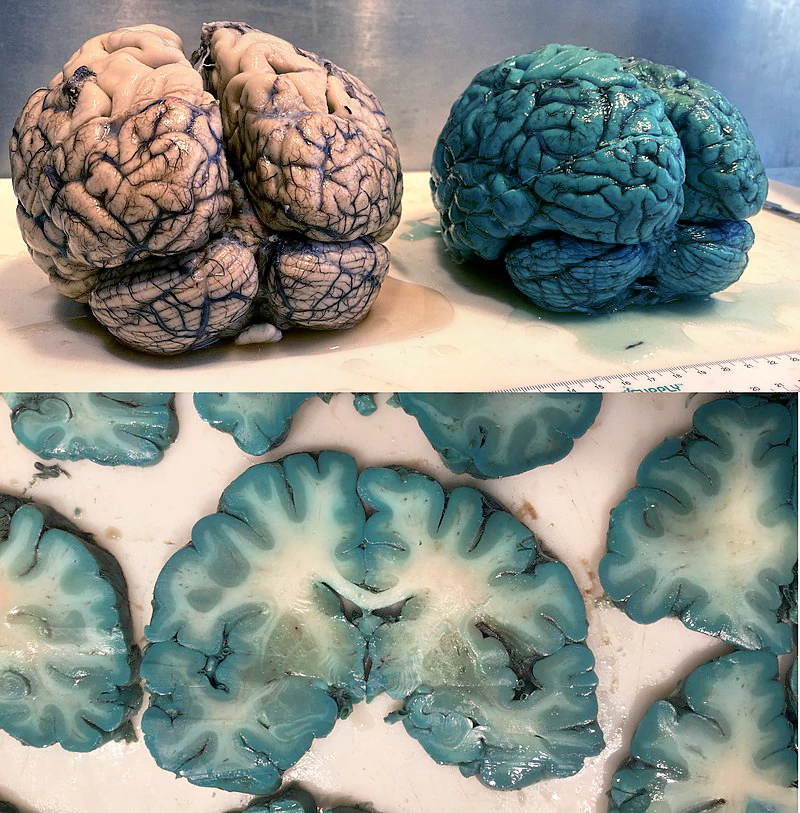
Methylene Blue’s Brain Power:
Stimule l'énergie et protège les neurones, ce qui est prometteur pour les maladies neurodégénératives, les lésions cérébrales et même le déclin cognitif lié à l'âge.
Le bleu de méthylène en tant qu'activateur de la sirtuine.
Le bleu de méthylène est un puissant agent anti-âge qui peut activer les sirtuines, des enzymes qui régulent la santé cellulaire et la longévité (Shin et al, 2014). Sirtuines sont essentiels au maintien d'un équilibre sain du NAD+, une molécule qui alimente la production et la réparation de l'énergie cellulaire. La MB peut augmenter le rapport NAD+/NADH dans les cellules hépatiques et stimuler SIRT1, qui à son tour réduit l'acétylation de PGC-1α, une protéine qui contrôle la biogenèse et la fonction mitochondriales.
En améliorant la fonction mitochondriale, la MB peut également augmenter la consommation d'oxygène et la production d'énergie dans le foie. Elle peut également activer d'autres voies métaboliques clés, telles que l'AMPK, la CPT-1 et la PPARα, qui sont impliquées dans l'oxydation des acides gras et l'homéostasie du glucose. L'activation de l'AMPK par la MB dépend de SIRT1.
Résumé:
Methylene blue’s ability to activate sirtuin enzymes, key regulators of cellular health and longevity, makes it a promising anti-aging agent in addition to its antioxidant and other beneficial properties. By boosting mitochondrial function and metabolism, it can potentially improve energy levels, protect cells, and even enhance liver function.
Avantages pour la peau.
Le bleu de méthylène peut protéger la peau du vieillissement et des dommages causés par le soleil en agissant comme un antioxydant, en stimulant la fonction mitochondriale, en stimulant la production de collagène et d'élastine et en absorbant les rayons UV (Xue et al, 2021). Il peut également favoriser la cicatrisation des plaies et la régénération des tissus en augmentant l'activité des fibroblastes, en réduisant la progression de la nécrose, en tuant les microbes et en asséchant l'excès d'humidité.
Le vieillissement est un processus naturel qui affecte la peau de différentes manières. La peau peut perdre son élasticité, son épaisseur, sa douceur et son hydratation. Il peut également rendre la peau plus sujette aux dommages, aux inflammations et aux infections.
Avec l'âge, les cellules de la peau deviennent moins actives et produisent moins de collagène et d'élastine, les protéines qui maintiennent la fermeté et l'élasticité de la peau. En outre, l'exposition aux rayons UV du soleil peut provoquer un stress oxydatif, des lésions de l'ADN et une inflammation de la peau, ce qui entraîne l'apparition de rides, d'un relâchement de la peau et d'une pigmentation.
L'un des moyens de protéger la peau contre les dommages causés par la lumière et le stress oxydatif consiste à utiliser des antioxydantsLe bleu de méthylène est un antioxydant puissant qui peut protéger la peau contre les radicaux libres en donnant des électrons. Le bleu de méthylène est un puissant antioxydant qui peut protéger la peau des radicaux libres en donnant des électrons et en stimulant l'activité des mitochondries. Le bleu de méthylène peut augmenter les niveaux de cytochrome oxydase, une enzyme qui aide les mitochondries à utiliser l'oxygène plus efficacement. Cela peut améliorer la respiration cellulaire en 37-70% et inverser les signes de vieillissement causés par les radicaux libres. toxines environnementales.
Il peut également stimuler la production de collagène et d'élastine dans la matrice extracellulaire (MEC), le réseau de fibres qui soutient la structure de notre peau (Xiong et al, 2017). Dans un modèle de tissu cutané en 3D, le traitement par MB a amélioré l'épaisseur et l'hydratation de la peau (Xiong et al, 2017). En outre, la MB peut absorber les rayons UV et prévenir les dommages causés à l'ADN par l'irradiation UVB dans les kératinocytes humains, les cellules qui forment la couche externe de notre peau.
Ces résultats suggèrent que la MB peut agir comme un écran solaire naturel et un agent anti-âge pour notre peau.
Un autre avantage de la MB pour votre peau est sa capacité à accélérer la cicatrisation des plaies et la régénération des tissus. Lorsque notre peau est blessée, nous avons besoin de notre fibroblastesLes cellules qui produisent le collagène et l'élastine migrent et prolifèrent rapidement pour refermer la plaie et restaurer l'intégrité de la peau.
La MB peut faciliter ce processus en favorisant la migration et la prolifération des fibroblastes dans le processus de cicatrisation. Dans des modèles animaux de brûlures cutanées, le traitement à la MB a réduit la progression de la nécrose, ce qui signifie qu'il a empêché la mort des tissus sains autour de la plaie. Cela peut être dû à la capacité de la MB à réduire le stress oxydatif et l'oxyde nitrique (NO).
La MB peut également contribuer à la cicatrisation des plaies en tuant les bactéries et les champignons susceptibles d'infecter la plaie et de provoquer des complications. En outre, elle peut assécher l'excès d'humidité de la plaie sans nuire aux cellules saines. Cela permet d'éviter l'hyper-granulation, une condition dans laquelle trop de tissu se développe sur la plaie et retarde la cicatrisation.
En appliquant la MB sur vos plaies, vous pouvez accélérer la cicatrisation, réduire le risque d'infection et améliorer la viabilité des tissus avec une irritation minimale.
Résumé:
Ce composé polyvalent s'attaque aux facteurs de vieillissement internes et externes. Il agit comme un antioxydant, stimulant la fonction mitochondriale et la production de collagène tout en protégeant votre peau des dommages causés par le soleil et en favorisant la régénération des tissus. Il s'agit d'un écran solaire naturel, d'un agent anti-âge et d'un accélérateur de cicatrisation, le tout en un seul produit !
Le bleu de méthylène dans la progéria.
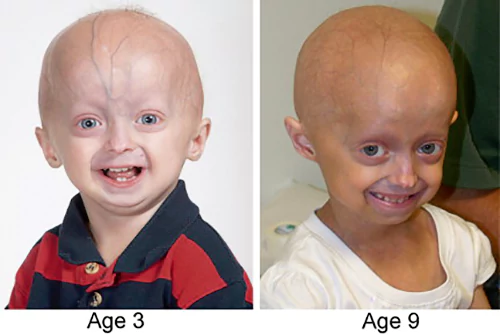
Le syndrome de Progéria de Hutchinson-Gilford (SPGH) est une maladie dévastatrice qui entraîne un vieillissement rapide et une mort prématurée des enfants. Il est dû à une mutation génétique qui fait que les cellules produisent une protéine défectueuse appelée progérine au lieu d'une protéine normale appelée Lamin A. La progérine adhère à l'enveloppe nucléaire, la membrane qui entoure le noyau de la cellule, et provoque sa déformation et son gonflement. Cela entraîne des changements dans l'expression des gènes, le stress cellulaire et le dysfonctionnement mitochondrial, qui sont des caractéristiques du vieillissement.
Il a été démontré que le bleu de méthylène a des effets antivieillissement en agissant comme un antioxydant mitochondrial et en améliorant la respiration cellulaire. Le bleu de méthylène peut traverser la membrane cellulaire et atteindre le noyau, où il peut dissoudre la progérine et restaurer la forme normale de l'enveloppe nucléaire (Xiong et al, 2016). Cela peut inverser les changements d'expression génétique et réduire le stress cellulaire dans les cellules HGPS. La MB peut également améliorer la fonction mitochondriale et réduire les dommages oxydatifs dans les cellules HGPS.
En dehors de cette maladie rare, la MB pourrait également avoir des effets bénéfiques sur le vieillissement normal et d'autres maladies liées au dysfonctionnement mitochondrial et au stress oxydatif. Si elle contribue à ralentir le vieillissement dans des cas aussi difficiles que la progéria, la logique veut qu'elle fasse de même chez les individus normaux, mais nous avons encore besoin de plus de recherches à cet égard. S'il est prouvé qu'il possède les mêmes propriétés antivieillissement dans les processus de vieillissement normal non liés à la progéria, il pourrait être l'un des premiers médicaments antivieillissement approuvés par la FDA.
Résumé:
Hutchinson-Gilford Progeria Syndrome (HGPS) causes rapid aging and premature death from a faulty protein, progerin that disrupts the cell’s nucleus. MB tackles progerin in the cell’s core by dissolving the harmful protein and restoring the nucleus to its rightful shape. This in turn, corrects gene expression, reduces stress, and rejuvenates mitochondria within the cell.
Dépression.
La dépression est un trouble mental courant et débilitant qui touche des millions de personnes dans le monde. Elle se caractérise par une baisse d'humeur persistante, une perte d'intérêt et une altération des fonctions cognitives. La dépression peut également coexister avec d'autres troubles neuropsychiatriques et des troubles neurodégénératifs. La dépression est un trouble mental qui touche des millions de personnes dans le monde. les causes de la dépression sont complexes et multifactorielles, impliquant des facteurs génétiques, environnementaux et biologiques.
La MB est un composé polyvalent qui peut cibler plusieurs mécanismes impliqués dans la dépression et les troubles connexes. En agissant sur les neurotransmetteurs, la cascade NO-cGMP et les mitochondries, la MB peut avoir des effets antidépresseurs, anxiolytiques et neuroprotecteurs.
Selon certaines études, le bleu de méthylène peut augmenter les niveaux de noradrénaline, sérotonine, et dopamine dans le cerveau en inhibant les enzymes qui dégradent ces neurotransmetteurs (Alda, 2019). Le bleu de méthylène inhibe l'activité de la monoamine oxydase et de l'acétylcholinestérase, augmentant ainsi les niveaux de catécholamines et d'acétylcholine. Il stimule également la sérotonine et la norépinéphrine. Ces neurotransmetteurs sont impliqués dans la régulation de l'humeur, de l'anxiété et de la mémoire. En augmentant leur taux, le bleu de méthylène peut contribuer à soulager la dépression et à améliorer les fonctions cognitives.
La MB pourrait offrir un traitement nouveau et efficace de la dépression et des troubles connexes en ciblant plusieurs voies et en agissant sur plusieurs enzymes et molécules qui régulent les niveaux de neurotransmetteurs. Elle peut également moduler la cascade oxyde nitrique (NO)-guanosine monophosphate cyclique (GMPc), qui est impliquée dans la neurobiologie de la dépression et de la psychose (Alda, 2019). En inhibant la production de NO et de GMPc, la MB peut avoir des effets antidépresseurs, anxiolytiques et neuroprotecteurs.
Mais la MB ne se contente pas d'influencer les neurotransmetteurs et les molécules de signalisation. Elle peut également agir comme un antioxydant mitochondrial et améliorer la respiration cellulaire. Le dysfonctionnement des mitochondries et le stress oxydatif sont liés à la dépression et à la neurodégénérescence. En donnant ou en acceptant des électrons de la chaîne respiratoire mitochondriale, la MB peut restaurer la fonction mitochondriale, améliorer la production d'énergie neuronale et prévenir les dommages oxydatifs (Yang et al, 2020). Ces effets peuvent également contribuer à l'activité thérapeutique de la MB.
L'utilisation de la MB dans la dépression avec des troubles neurodégénératifs, comme la maladie d'Alzheimer et la maladie de Parkinson, représente également une stratégie particulièrement pertinente. En ciblant à la fois les systèmes de neurotransmetteurs et la fonction mitochondriale, la MB peut améliorer à la fois l'humeur et les symptômes cognitifs de ces patients.
Les doses utilisées dans les études peuvent varier considérablement. Dans cette étude, ils n'ont utilisé que 15 mg (Naylor et al, 1987) et ont obtenu, selon leurs dires, une amélioration significativement plus importante chez les patients recevant du bleu de méthylène. Dans la plupart des autres études, les dosages sont plus élevés, dans celle-ci par exemple, ils ont comparé un dosage de 300 mg à un dosage de 15 mg (Naylor et al, 1986) pendant deux ans, à raison d'un an par dose. Les patients recevant 300 mg/jour étaient significativement moins déprimés que pendant l'année où ils recevaient 15 mg/jour, mais aucune différence significative n'a été constatée dans la sévérité des symptômes maniaques.
Résumé:
Methylene blue’s unique multifaceted approach, targeting neurotransmitters, nitric oxide signaling, and mitochondrial function, shows potential as a novel and effective treatment for depression and related disorders, offering both mood and cognitive benefits.
Le trouble bipolaire.
Les personnes ayant trouble bipolaire sont souvent confrontés à des symptômes résiduels, tels qu'une humeur maussade, de l'anxiété et des troubles cognitifs, même lorsqu'ils prennent des médicaments.
Une étude récente réalisée par (Alda et al. 2017) a testé l'effet de la MB sur des patients atteints de troubles bipolaires qui prenaient déjà de la lamotrigine, un stabilisateur d'humeur. Il s'agissait d'une étude croisée en double aveugle, ce qui signifie que les patients ont reçu soit une faible dose (15 mg), soit une dose active (195 mg) de MB pendant 12 semaines, puis sont passés à l'autre dose pendant 12 semaines supplémentaires. L'étude a mesuré la sévérité de la dépression, de la manie, de l'anxiété et du fonctionnement cognitif.
L'étude a montré que la dose active de MB améliorait significativement les symptômes de dépression et d'anxiété par rapport à la dose faible. Les symptômes de manie sont restés faibles et stables tout au long de l'étude. Les effets de la MB sur les symptômes cognitifs n'étaient pas significatifs. Le médicament a été bien toléré avec des effets secondaires légers et transitoires.
Ces résultats suggèrent que la MB peut être utilisée comme médicament d'appoint pour améliorer les symptômes résiduels de dépression et d'anxiété chez les patients atteints de troubles bipolaires. Elle pourrait également avoir un effet stabilisateur de l'humeur dans le traitement à long terme du trouble bipolaire.
Résumé:
Le bleu de méthylène, en tant que médicament d'appoint dans les troubles bipolaires, semble prometteur pour réduire de manière significative la dépression résiduelle et l'anxiété sans exacerber la manie.
Amélioration cognitive.
Le bleu de méthylène peut améliorer votre mémoire et protéger votre cerveau des dommages. Il stimule la fonction métabolique des cellules cérébrales, les rendant plus énergiques et plus résistantes.
Le bleu de méthylène peut stimuler acétylcholine dans le cerveau en inhibant l'enzyme qui la décompose, appelée acétylcholinestérase. L'acétylcholine est un neurotransmetteur impliqué dans la mémoire, l'apprentissage, l'attention et d'autres fonctions cognitives. En empêchant la dégradation de l'acétylcholine, la MB peut améliorer la disponibilité et la signalisation de ce neurotransmetteur dans le cerveau. Cela pourrait expliquer pourquoi il a été démontré que la MB améliore la rétention de la mémoire et les performances cognitives dans diverses tâches et conditions.
La MB ne ressemble à aucune autre drogue, car elle n'agit pas sur des récepteurs spécifiques et ne produit pas d'effets prévisibles. Elle a une réponse hormétique à la dose, ce qui signifie qu'elle a des effets opposés à faible et à forte dose (Bruchey & Gonzalez-Lima, 2008). À faible dose, la MB agit comme un donneur d'électrons dans la chaîne de transport d'électrons des mitochondries, qui est responsable de la production d'énergie à partir de l'oxygène. Cela confère à la MB des propriétés antioxydantes et d'amélioration de la respiration cellulaire inégalées qui affectent le système nerveux de diverses manières.
L'un des principaux effets de la MB est d'augmenter l'activité de l'enzyme respiratoire cytochrome oxydase, qui joue un rôle clé dans la consolidation de la mémoire. La MB améliore la consolidation de la mémoire de manière sélective et adaptative, en fonction du type et de l'intensité de la tâche de mémorisation. De plus, de faibles doses de MB ont été utilisées pour prévenir et traiter des troubles cérébraux impliquant un dysfonctionnement mitochondrial, tels que la maladie d'Alzheimer, la maladie de Parkinson et les accidents vasculaires cérébraux. La MB possède une propriété auto-oxydante unique qui lui permet d'interagir avec différentes oxydases tissulaires et de moduler leur activité. Cela explique pourquoi la MB a de puissants effets neuroprotecteurs à faibles doses. Dans cet article (Rojas et al, 2012), ils ont passé en revue les preuves qui soutiennent le rôle mécaniste de la MB à faible dose en tant qu'intervention prometteuse et sûre pour améliorer la mémoire et traiter les conditions aiguës et chroniques caractérisées par le stress oxydatif, la neurodégénérescence et les troubles de la mémoire.
Résumé:
Methylene Blue’s ability to boost both acetylcholine levels (the key enzyme in memory consolidation) and mitochondrial activity in the brain holds potential for enhancing memory and preventing brain disorders like Alzheimer’s and Parkinson’s.
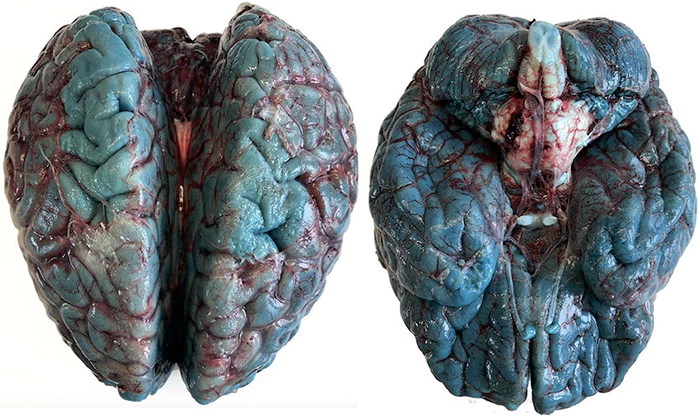
La MB peut traverser la barrière hémato-encéphalique et cibler sélectivement le tissu cérébral après avoir été injectée dans le corps. Ce phénomène a été découvert pour la première fois par Paul Ehrlich en 1886, qui l'a qualifié de "balle magique" pouvant être utilisée pour traiter sélectivement des maladies in vivo. Ce concept est devenu la base de la chimiothérapie moderne. La MB peut colorer en bleu les cellules nerveuses du cerveau et les rendre visibles après dissection. La MB peut également s'accumuler dans le cerveau à des concentrations plus élevées que dans le sang, ce qui en fait un candidat idéal pour affecter les fonctions cérébrales.
Plusieurs études ont montré que la MB peut améliorer la mémoire dans différents types de tâches d'apprentissage et dans différentes populations. Les effets d'amélioration de la mémoire de la MB ont été rapportés pour la première fois par (Martinez et al, 1978) qui ont constaté que 1 mg/kg de MB administré immédiatement après l'entraînement améliorait la rétention de la mémoire dans une tâche d'évitement inhibiteur chez les rats. Cette tâche consiste à apprendre à éviter une chambre noire dans laquelle un choc électrique léger a été administré. (Callaway et al, 2002) ont constaté que la MB augmentait la rétention de la mémoire dans la reconnaissance d'objets, l'habituation entre deux jours à un environnement familier, ainsi que la rétention de la mémoire spatiale et l'apprentissage par inversion dans le labyrinthe à trous appâté chez les rats. Ces tâches impliquent la reconnaissance d'objets ou de lieux nouveaux ou l'apprentissage de nouvelles règles. (Gonzalez-Lima & Bruchey, 2004) ont constaté que la MB améliorait la rétention de la mémoire de l'extinction du conditionnement de peur pavlovien chez les rats. Cette tâche consiste à apprendre à supprimer une réaction de peur conditionnée à un stimulus qui a été précédemment associé à un événement aversif.
Il a été prouvé que la MB améliore la rétention de la mémoire chez les rats dans diverses tâches, comme se souvenir de l'endroit où trouver de la nourriture, éviter un danger, reconnaître des objets et surmonter la peur. Mais qu'en est-il de l'apprentissage plus complexe qui nécessite un entraînement répété sur plusieurs jours ? Cette étude (Wrubel et al, 2007) a étudié l'influence de la MB sur la mémoire de discrimination spatiale chez les rats à l'aide d'un labyrinthe à trous. Les rats devaient apprendre quels trous étaient appâtés avec de la nourriture et lesquels ne l'étaient pas. Les chercheurs ont constaté que les rats ayant reçu des injections de MB après chaque séance d'entraînement apprenaient plus vite et mieux que les rats ayant reçu des injections de solution saline. Ils ont également constaté que la MB augmentait l'activité d'une enzyme appelée cytochrome oxydase dans le cerveau des rats, qui est responsable de la production d'énergie à partir de l'oxygène. L'activité de la cytochrome oxydase dans le cerveau du groupe traité par la MB était environ 70% plus élevée que chez les rats ayant reçu une solution saline. Cela suggère que la MB améliore la consolidation de la mémoire en augmentant l'approvisionnement en énergie des régions du cerveau impliquées dans l'apprentissage. Cette étude montre que la MB est un puissant stimulant de la mémoire qui peut améliorer l'apprentissage au fil des jours en renforçant la capacité métabolique du cerveau.
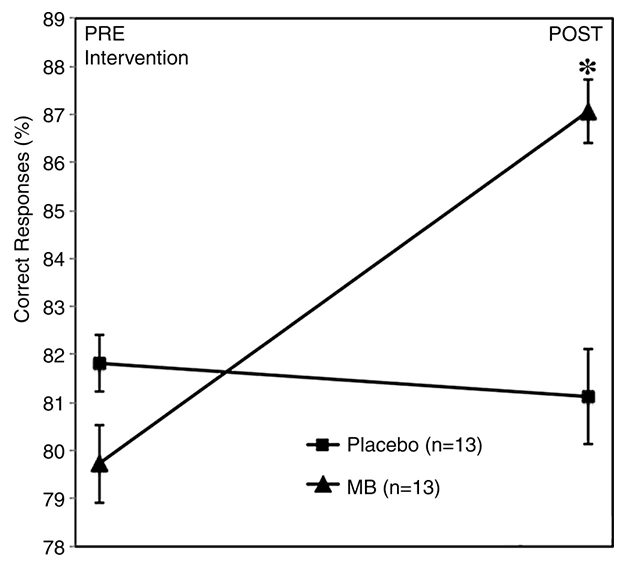
La MB peut également améliorer la mémoire chez les personnes souffrant ou non de troubles cognitifs. Elle le fait en améliorant le flux sanguin et l'apport d'oxygène aux cellules du cerveau, ce qui les rend plus alertes et plus efficaces. La MB a été testée dans le cadre d'un essai clinique (Rodriguez et al. 2016) avec des volontaires sains qui ont subi des examens d'IRM fonctionnelle avant et après avoir pris de la MB ou un placebo. Les chercheurs voulaient voir comment la MB affecte les régions du cerveau impliquées dans l'attention soutenue et la mémoire à court terme. L'attention soutenue est la capacité de rester concentré et alerte pendant une longue période. La mémoire à court terme est la capacité de stocker et de rappeler des informations pendant quelques secondes ou quelques minutes.
Les résultats sont significatifs. La MB a augmenté l'activité cérébrale dans le cortex insulaire, une partie du cerveau qui régule l'attention, les émotions et la conscience de soi. Elle a également augmenté l'activité cérébrale dans les cortex préfrontal, pariétal et occipital, qui sont des parties du cerveau impliquées dans l'encodage, le stockage et la récupération de la mémoire. Elle a également amélioré les performances de la mémoire des volontaires, qui ont été capables de se rappeler plus d'informations correctement.
Cette étude montre que la MB à faible dose peut améliorer les fonctions cérébrales et la cognition en augmentant le flux sanguin et l'apport d'oxygène aux cellules cérébrales. Elle montre également que l'IRM fonctionnelle peut être utilisée pour mesurer les effets de la MB sur le cerveau in vivo.
Résumé:
Le bleu de méthylène a la capacité unique de traverser la barrière hémato-encéphalique, de cibler directement le tissu cérébral et de s'y accumuler. En stimulant à la fois l'énergie et le flux sanguin, il présente un potentiel impressionnant d'amélioration de la mémoire chez les animaux et les humains, avec ou sans troubles cognitifs.
Traitement potentiel de la maladie d'Alzheimer.
Le bleu de méthylène est une substance polyvalente qui peut aider à lutter contre la maladie d'Alzheimer, une affection dévastatrice qui touche des millions de personnes dans le monde. La maladie d'Alzheimer entraîne une perte progressive de la mémoire, déclin cognitifLa maladie d'Alzheimer se caractérise par des troubles de l'humeur et du comportement dus à l'accumulation de dépôts de protéines anormales et à la détérioration des cellules cérébrales. Il a été démontré que la MB peut contrecarrer certaines des principales caractéristiques de la MA en interférant avec de multiples processus cellulaires et moléculaires impliqués dans la maladie. Le bleu de méthylène peut empêcher la formation de plaques amyloïdes et d'enchevêtrements neurofibrillaires, qui sont les signes distinctifs de la maladie d'Alzheimer. Le bleu de méthylène a une action inhibitrice sur la voie du GMPc. Le bleu de méthylène peut également améliorer la fonction et le métabolisme des mitochondries. Il peut également moduler divers systèmes de neurotransmetteurs, tels que l'acétylcholine, la sérotonine et le glutamate, qui sont importants pour la mémoire, l'humeur et l'apprentissage. En agissant sur ces différents aspects de la MA, la MB peut ralentir la progression de la maladie et améliorer la qualité de vie des patients atteints de la MA (Oz et al, 2009).
La protéine Tau contribue normalement à stabiliser la structure des cellules nerveuses du cerveau, mais dans certaines maladies, comme la maladie d'Alzheimer, elle devient anormale et forme des amas appelés fibrilles qui endommagent les cellules. Les scientifiques cherchent des moyens d'empêcher la protéine Tau de former des fibrilles et de protéger le cerveau de la dégénérescence. L'une des solutions consiste à utiliser de petites molécules capables d'interférer avec la fibrillation de la protéine Tau.
La MB peut empêcher la protéine Tau de former des fibrilles en modifiant sa structure chimique (Crowe et al, 2013).
Elle le fait en donnant des électrons aux deux résidus de cystéine de la protéine Tau, qui sont des acides aminés contenant du soufre. La protéine Tau forme alors une liaison disulfure, c'est-à-dire un lien entre deux atomes de soufre. Cela rend la protéine Tau plus compacte et moins encline à former des fibrilles. Cependant, cela ne fonctionne que pour un type de Tau, appelé Tau 4-R, qui comporte quatre répétitions d'une certaine séquence. Un autre type de Tau, appelé Tau 3-R, qui comporte trois répétitions, peut encore former des fibrilles après avoir été oxydé par la MB. En fait, la MB peut faire en sorte que la protéine Tau 3-R forme des dimères, c'est-à-dire des paires de molécules qui peuvent servir de germes pour la formation de fibrilles. La MB peut également oxyder les résidus de cystéine dans d'autres molécules qui ne sont pas liées à la protéine Tau. Cela signifie que la MB peut avoir des effets secondaires indésirables sur d'autres fonctions cellulaires.
La MB fait actuellement l'objet d'essais cliniques en tant que nouveau traitement de la maladie d'Alzheimer.
Résumé:
Methylene Blue’s potential against Alzheimer’s lies in its multi-pronged attack, hindering plaque formation, protecting mitochondria, and even preventing a specific form of harmful Tau protein from clumping, offering hope for slowing disease progression and improving quality of life for patients.
Traitement potentiel de la maladie de Parkinson.
La maladie de Parkinson (MP) est une affection neurodégénérative qui touche des millions de personnes dans le monde. Elle entraîne une perte progressive des neurones producteurs de dopamine dans le cerveau, ce qui se traduit par des symptômes tels que des tremblements, une rigidité, une lenteur des mouvements et des troubles de l'équilibre. La MP affecte également d'autres aspects du cerveau, comme l'odorat, qui est souvent réduit ou perdu aux premiers stades de la maladie.
L'une des principales causes de la MP est le stress oxydatif, c'est-à-dire un déséquilibre entre la production et l'élimination de molécules nocives appelées radicaux libres. Ces radicaux libres peuvent endommager les mitochondries, qui sont les centrales énergétiques des cellules. Lorsque les mitochondries sont endommagées, les cellules ne peuvent plus fonctionner correctement et finissent par mourir.
Les scientifiques ont cherché des moyens de protéger les mitochondries du stress oxydatif et d'améliorer leur production d'énergie. Le bleu de méthylène est un candidat prometteur.
Des études récentes ont montré que la MB peut prévenir ou réduire la perte de neurones dopaminergiques et améliorer la fonction motrice dans des modèles animaux de la MP exposés à des toxines qui imitent la maladie. Toutefois, ces études ont utilisé des modèles de toxines aiguës, qui ne reflètent pas entièrement la nature chronique de la MP. En outre, aucune étude n'a examiné si la MB pouvait également améliorer la fonction olfactive, qui est une caractéristique non motrice importante de la MP.
Pour combler ces lacunes, les chercheurs de cette étude ont injecté à des souris une toxine appelée MPTP, qui provoque des symptômes semblables à ceux de la maladie de Parkinson et une neurodégénérescence (Biju et al, 2018). Ils ont administré aux souris dix doses de MPTP sur une période de 35 jours, ainsi qu'un médicament appelé probénécide qui aide le MPTP à pénétrer dans le cerveau. Ils ont ensuite traité certaines souris avec de faibles doses de MB dans leur eau de boisson, à partir du moment où elles ont remarqué une diminution de leur odorat.
Les souris ayant reçu de la MB ont montré une amélioration significative de leur coordination motrice, par rapport aux souris n'ayant pas reçu de MB. Elles avaient également plus de neurones dopaminergiques dans leur cerveau et plus de terminaux dopaminergiques dans leur striatum, la région qui contrôle les mouvements. Plus important encore, leur odorat a été restauré par le traitement à la MB, alors qu'il restait altéré chez les souris non traitées.
Ces résultats suggèrent que de faibles doses de MB peuvent protéger les fonctions motrices et non motrices dans la maladie de Parkinson en améliorant la fonction mitochondriale et en réduisant le stress oxydatif.
Cela fait de la MB un traitement potentiel de la MP qui pourrait être plus efficace et plus sûr que les médicaments actuels, car elle s'attaque à la cause première de la maladie, contrairement aux médicaments modernes qui ne s'attaquent qu'aux symptômes moteurs et ont de nombreux effets secondaires. En outre, la MB peut être facilement administrée par voie orale, son coût est faible et son utilisation clinique est ancienne.
Cependant, avant que la MB puisse être utilisée pour les patients atteints de la maladie de Parkinson, d'autres études sont nécessaires pour confirmer sa sécurité et son efficacité chez l'homme.
Résumé:
Methylene Blue’s ability to shield mitochondria and boost dopamine production holds promise for treating both movement and non-motor symptoms in Parkinson’s disease, potentially offering a safer and more comprehensive approach than existing therapies.
Le bleu de méthylène comme nootrope.
De nombreuses personnes qui utilisent le bleu de méthylène disent qu'il les aide à comprendre mieux et plus rapidement des sujets complexes. Elles disent qu'elles peuvent facilement se rappeler ce qu'elles ont appris et l'appliquer dans différentes situations. Le bleu de méthylène semble améliorer la compréhension et la rétention de l'information dès le premier essai. Si vous êtes un étudiant, vous pourriez vouloir l'essayer.
De nombreuses personnes déclarent également que le bleu de méthylène améliore leur humeur. Elles disent que le bleu de méthylène les aide à oublier les aspects négatifs de leurs expériences et à se concentrer sur les aspects positifs. Le bleu de méthylène peut aider à reconnecter le cerveau pour réduire le stress et l'anxiété, même à faible dose.
Certaines personnes disent que le bleu de méthylène les rend plus énergiques et plus confiants. Elles affirment qu'il stimule leurs performances physiques et leur récupération.
Certaines personnes affirment également qu'il améliore la qualité et la durée de leur sommeil. Elles disent se réveiller en pleine forme et prêtes à affronter la journée. Le bleu de méthylène peut aider à réguler le rythme circadien, le cycle naturel de l'horloge biologique.
Le bleu de méthylène est un nootropique qui peut offrir de nombreux avantages à votre cerveau et à votre corps. Il peut vous aider à mieux apprendre, à vous souvenir davantage, à vous sentir plus heureux, à être plus performant et à dormir plus profondément.
Résumé:
Methylene Blue’s reported nootropic benefits, ranging from improved learning and mood to enhanced physical performance and sleep, make it a promising candidate for a potential one-stop shop for enhancing both cognitive function and overall well-being.
Maladie de Lyme et co-infections.
La plupart des personnes atteintes de la maladie de Lyme peuvent être guéries par des antibiotiques, mais certaines d'entre elles souffrent encore de complications à long terme. Cet état est appelé syndrome post-traitement de la maladie de Lyme (SPTL) et peut affecter la qualité de vie des patients. La raison pour laquelle certaines personnes développent un syndrome post-traitement de la maladie de Lyme n'est pas claire, mais elle pourrait être liée à la persistance de la bactérie responsable de la maladie de Lyme. Ces bactéries, appelées Borrelia burgdorferi, peuvent se cacher dans l'organisme et résister aux effets des antibiotiques.
Il est donc nécessaire de trouver de nouveaux médicaments capables de tuer Borrelia burgdorferi de manière plus efficace et de prévenir le SDTLP.
En laboratoire, la MB a tué efficacement les bactéries de Lyme résistantes aux antibiotiques (Feng et al, 2015). Dans cette étude, ils font état de 113 médicaments supplémentaires dont l'activité est encore plus élevée que celle des antibiotiques actuellement utilisés pour traiter la maladie de Lyme.
La combinaison du bleu de méthylène avec des antibiotiques augmente également l'efficacité des antibiotiques qui combattent la maladie de Lyme (Horowitz & Freeman, 2022).
Des études ont également montré que la combinaison du bleu de méthylène avec des antibiotiques est plus efficace que les antibiotiques seuls pour traiter d'autres types d'infections à Bartonella (Zheng et al, 2020). Bartonella henselae est une bactérie à Gram négatif transmise à l'homme par une griffure de chat en présence d'ectoparasites. Les humains infectés par B. henselae peuvent présenter diverses maladies cliniques, notamment une lymphadénopathie locale et des maladies systémiques plus graves telles qu'une bactériémie persistante et une endocardite. Parmi tous les médicaments disponibles dans l'étude, le bleu de méthylène et la rifampicine étaient les agents les plus actifs contre le biofilm de B. henselae après 6 jours d'exposition au médicament. Les combinaisons d'antibiotiques (azithromycine/ciprofloxacine, azithromycine/bleu de méthylène, rifampicine/ciprofloxacine, rifampicine/bleu de méthylène) ont complètement éradiqué le biofilm B. henselae après un traitement de 6 jours.
Résumé:
Le bleu de méthylène, seul ou en combinaison avec des antibiotiques, présente un potentiel prometteur pour l'éradication des bactéries de Lyme et de Bartonella résistantes aux antibiotiques. Il s'agit donc d'un outil prometteur pour le traitement des infections chroniques et de leurs complications.
Le paludisme.
Le bleu de méthylène est un composé synthétique qui a une longue histoire dans la lutte contre le paludisme. Il a été le premier médicament fabriqué par l'homme à cibler le parasite mortel et il a été largement utilisé à la fin des années 1800 et au début des années 1900. Mais la MB n'est pas qu'une relique du passé. Des recherches récentes ont montré que la MB peut encore être une arme puissante contre le paludisme, en particulier lorsqu'elle est associée à d'autres médicaments. Elle peut tuer Plasmodium falciparum, le type de paludisme le plus dangereux, lors de tests en laboratoire, sur des souris et des singes. Il peut également vaincre la résistance que certaines souches de P. falciparum et de P. vivax ont développée à l'égard d'autres antipaludiques. En outre, la MB peut réduire la transmission du paludisme en tuant les gamétocytes, le stade sexuel du parasite qui infecte les moustiques. Cela en fait un partenaire prometteur pour la thérapie combinée à base d'artémisinine (ACT), le traitement standard actuel du paludisme. La TCA vise à éliminer le paludisme des régions où il est endémique, mais elle se heurte à des difficultés telles que la résistance aux médicaments et le manque d'observance. La MB pourrait améliorer l'efficacité et la sécurité de l'ACT en renforçant son activité antiparasitaire et en réduisant ses effets secondaires.
Cette étude (Lu et al, 2018) passe en revue la littérature scientifique publiée jusqu'au début de l'année 2017 afin de fournir une vue d'ensemble des avantages et des risques potentiels de l'utilisation des MB pour traiter le paludisme.
L'étude a analysé 22 articles portant sur 21 études impliquant 1504 patients atteints de paludisme (dont deux tiers d'enfants). Les études les plus anciennes se sont concentrées sur la MB en tant que médicament unique, tandis que les plus récentes ont testé la MB en association avec d'autres antipaludiques. Les résultats ont montré que la MB était très efficace contre le paludisme dans différentes régions et qu'elle avait un fort impact sur la réduction de la transmission du parasite en tuant les gamétocytes, le stade sexuel qui infecte les moustiques. Elle a également renforcé l'action de la thérapie combinée à base d'artémisinine (ACT), le traitement standard actuel du paludisme. La TCA vise à éliminer le paludisme des régions où il est endémique, mais elle se heurte à des difficultés telles que la résistance aux médicaments et le manque d'observance. La MB pourrait améliorer l'efficacité et la sécurité de l'ACT en renforçant son activité antiparasitaire et en réduisant ses effets secondaires.
Les effets secondaires les plus fréquents de la MB étaient de légers symptômes urogénitaux et gastro-intestinaux et une coloration bleue de l'urine. Chez les personnes présentant un déficit en glucose-6-phosphate déshydrogénase (G6PD), une maladie génétique qui affecte les globules rouges, la MB a provoqué une baisse légère mais non cliniquement significative du taux d'hémoglobine.
L'étude conclut que des recherches supplémentaires sont nécessaires pour explorer les effets de la MB sur le paludisme en dehors de l'Afrique et sur Plasmodium vivax, un autre type de parasite du paludisme. L'étude suggère également que l'ajout de MB à l'ACT pourrait être une stratégie précieuse pour prévenir le développement de la résistance et pour réduire la transmission dans les programmes de contrôle et d'élimination.
Résumé:
Methylene Blue’s effectiveness in killing resistant malaria parasites and enhancing standard treatment, while reducing transmission, makes it a promising tool for tackling malaria, especially in areas facing resistance.
Bleu de méthylène pour la méthémoglobinémie.
La méthémoglobinémie est une affection grave qui réduit la capacité du sang à transporter l'oxygène. Elle survient lorsqu'une partie ou la totalité des atomes de fer des molécules d'hémoglobine passent de la forme ferreuse normale [Fe2+] à la forme oxydée anormale ferrique [Fe3+]. Lorsque l'hémoglobine est oxydée et contient du fer sous forme ferrique, le fer ferrique ne peut plus se lier à l'oxygène et le transporter car il est déjà oxydé, de sorte que le sang devient moins efficace pour fournir de l'oxygène aux tissus. Ce sang présente des changements de couleur distinctifs, passant de la couleur rouge normale à une couleur brun foncé ou chocolat. Il en résulte une anémie fonctionnelle qui peut mettre la vie en danger. Le traitement de la méthémoglobinémie consiste à éliminer la cause de l'affection et à vous administrer un antidote, le bleu de méthylène (chlorure de tétraméthylthionine) (Ludlow, 2022).
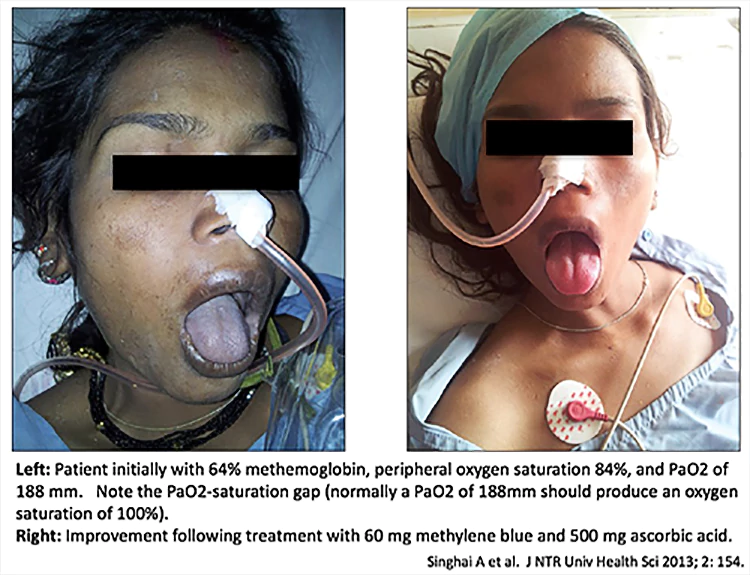
Le bleu de méthylène agit en interagissant avec une voie secondaire qui réduit la méthémoglobine en hémoglobine. Cette voie implique une enzyme appelée NADPH-MetHb réductase, qui utilise le NADPH provenant du shunt hexose monophosphate dépendant de la G6PD pour réduire le bleu de méthylène en bleu de leucométhylène. Le bleu de leucométhylène agit alors comme donneur d'électrons pour réduire la méthémoglobine en hémoglobine. Le bleu de méthylène est généralement très efficace et rapide dans le traitement de la méthémoglobinémie causée par des facteurs externes. Vous devez recevoir du bleu de méthylène si votre taux de méthémoglobine est supérieur à 20-30%, ou si vous présentez des symptômes tels que des maux de tête, des vertiges, un essoufflement ou des douleurs thoraciques. La dose de bleu de méthylène est de 1 à 2 mg/kg (0,1 à 0,2 ml/kg de solution de 1%) administrée par voie intraveineuse en 5 minutes. Une seconde dose peut être nécessaire après 30 à 60 minutes si les symptômes ou les taux ne s'améliorent pas.
Le bleu de méthylène a quelques effets secondaires que vous devez connaître. Le plus courant est la coloration verte ou bleue de l'urine, mais cet effet est inoffensif et temporaire. Cependant, le bleu de méthylène peut également avoir des effets secondaires graves car c'est un agent oxydant et un inhibiteur de la monoamine oxydase A (MAO-A). En tant qu'agent oxydant, le bleu de méthylène peut paradoxalement aggraver la méthémoglobinémie ou provoquer une hémolyse (destruction des globules rouges) s'il est administré à des doses très élevées ou s'il n'est pas correctement réduit. En tant qu'inhibiteur de la MAO-A, le bleu de méthylène peut interagir avec certains médicaments qui affectent les niveaux de sérotonine, tels que les antidépresseurs, et provoquer un syndrome sérotoninergique s'il est administré à fortes doses. Le bleu de méthylène est également déconseillé aux nouveau-nés et aux femmes enceintes, car ils sont plus sensibles aux agents oxydants et le bleu de méthylène peut nuire au fœtus.
Résumé:
Si votre sang devient brunâtre et votre urine bleue, soupçonnez une méthémoglobinémie et consultez immédiatement un médecin pour un traitement au bleu de méthylène, un antidote rapide et efficace.
Bleu de méthylène dans le choc septique et la vasoplégie.
Le bleu de méthylène est également un traitement potentiel du choc septique, une affection potentiellement mortelle qui survient lorsque la réaction de l'organisme à une infection provoque une hypotension artérielle et une défaillance des organes (Puntillo et al, 2020).
Le bleu de méthylène agit en bloquant la production d'oxyde nitrique, une molécule qui provoque le relâchement et l'élargissement des vaisseaux sanguins. Ce faisant, le bleu de méthylène peut augmenter votre tension artérielle et améliorer le flux sanguin vers vos organes. Le bleu de méthylène peut vous être administré par votre médecin si d'autres médicaments appelés vasopresseurs ne sont pas suffisamment efficaces.
Le bleu de méthylène peut également aider à traiter d'autres affections liées à l'hypotension artérielle, telles que la vasoplégie. La vasoplégie est un état de faible résistance vasculaire qui peut survenir après une chirurgie cardiaque ou en cas de choc septique. Le bleu de méthylène peut aider à rétablir le tonus et la réactivité normaux de vos vaisseaux sanguins.
Cependant, le bleu de méthylène n'est pas sans danger.
Si vous souffrez d'hypertension artérielle, vous devez être très prudent lorsque vous prenez du bleu de méthylène. Le bleu de méthylène peut augmenter votre tension artérielle de manière trop importante et entraîner de graves complications.
Résumé:
Methylene Blue’s ability to raise blood pressure and improve blood flow makes it a promising treatment for septic shock and other conditions related to low blood pressure, but use caution if you already have high blood pressure.
Infections fongiques.
Le bleu de méthylène aide à lutter contre les infections fongiques de la même manière qu'il aide à lutter contre les infections bactériennes.
Il est traditionnellement utilisé en aquaculture. Le bleu de méthylène est un désinfectant sûr pour les aquariums et peut également être utilisé pour le traitement de l'empoisonnement à l'ammoniaque et au nitrite. En aquaculture, il sert de médicament antifongique et antiparasitaire.. Il est couramment utilisé pour traiter les œufs de poisson afin de s'assurer qu'ils ne sont pas perdus à cause d'une prolifération fongique.
Il est également utilisé en médecine pour traiter les infections fongiques chez l'homme. Des millions de personnes souffrent de mycoses des ongles de pied, de muguet buccal, de formes plus graves d'infections à candida et de tous les autres types d'infections fongiques.
La mycose des ongles de pied est causée par un type de champignon appelé Trichophyton rubrum. La mycose de l'ongle du pied peut être difficile à traiter avec des médicaments conventionnels, qui peuvent avoir des effets secondaires ou être inefficaces. C'est pourquoi certains chercheurs explorent une nouvelle façon de traiter la mycose de l'ongle de l'orteil : la thérapie photodynamique (PDT) avec le bleu de méthylène.
La PDT est une technique qui utilise un colorant et une lumière pour tuer les cellules fongiques. Dans cette étude (Figueiredo Souza et al, 2014), les chercheurs ont testé l'efficacité de la PDT avec MB sur 22 patients atteints de mycose des ongles d'orteil. Ils ont divisé les patients en deux groupes : l'un présentait une mycose sévère des ongles d'orteil, l'autre une mycose légère à modérée des ongles d'orteil. Ils ont appliqué une solution de 2% MB sur les ongles affectés et les ont exposés à une diode électroluminescente (LED) d'une longueur d'onde de 630 nm et d'une énergie de 36 J/cm2. Ils ont répété ce processus toutes les deux semaines pendant six mois.
Tous les patients atteints d'une mycose de l'ongle de l'orteil légère à modérée ont été guéris par la PDT avec MB, tandis que 63,6% des patients atteints d'une mycose sévère de l'ongle de l'orteil ont montré une amélioration. Cela signifie que la PDT avec MB est un traitement prometteur pour la mycose de l'ongle de l'orteil, en particulier pour les cas légers à modérés. Toutefois, des recherches supplémentaires sont nécessaires pour confirmer son innocuité et son efficacité dans le cadre d'essais à plus grande échelle.
Candida albicans est un autre champignon plus dangereux qui peut provoquer des infections chez l'homme, en particulier lorsque son système immunitaire est affaibli. Ces infections peuvent être graves, voire mortelles. Malheureusement, C. albicans peut devenir résistant aux médicaments antifongiques habituels, ce qui rend le traitement plus difficile. C'est pourquoi les chercheurs cherchent de nouveaux moyens de combattre ce champignon.
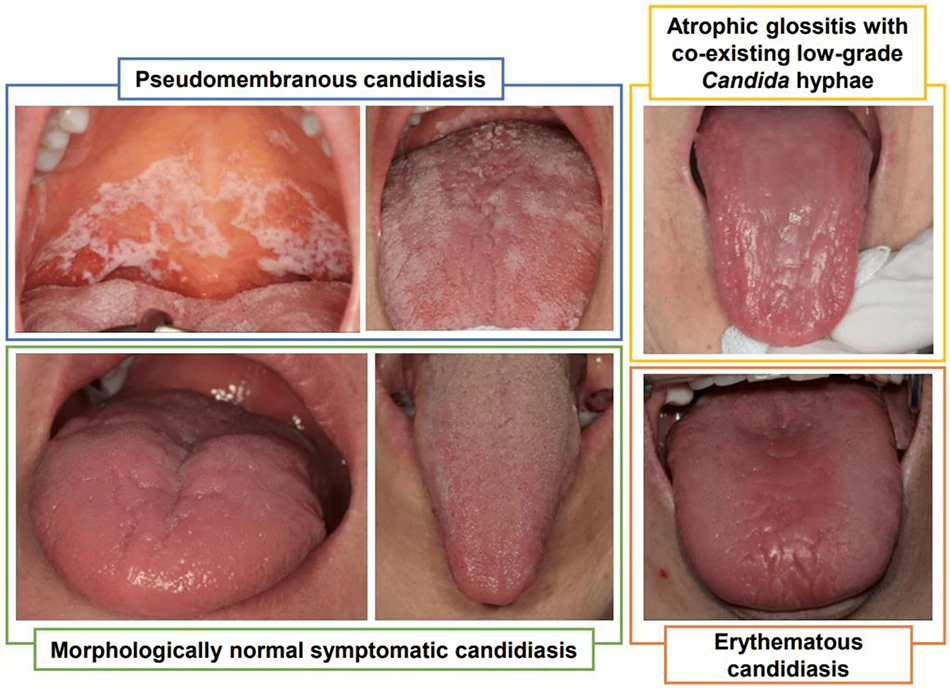
Le bleu de méthylène peut également tuer des champignons comme le Candida albicans, qui peut provoquer des infections vaginales à levures.
La MB cible trois aspects principaux du Candida albicans : ses mitochondries, son cycle d'oxydoréduction et sa membrane. Les mitochondries sont les parties de la cellule qui produisent de l'énergie, et le cycle redox est le processus de transfert des électrons entre les molécules. Les MB perturbent ces deux processus, ce qui entraîne une perte d'énergie et d'équilibre dans les cellules fongiques. La MB endommage également la membrane. Elle rend la membrane perméable et faible, ce qui facilite l'attaque des cellules fongiques par d'autres médicaments ou par le système immunitaire.
Une autre caractéristique importante de Candida albicans est sa capacité à changer de forme, de levure à hyphes. Les levures sont des cellules rondes et uniques, tandis que les hyphes sont des structures longues et ramifiées. Les hyphes permettent au Candida albicans d'envahir les tissus et d'échapper au système immunitaire, ce qui le rend plus virulent ou nocif. La MB empêche le Candida albicans de se transformer en hyphes et le maintient sous la forme moins dangereuse de levure.
Il peut également agir comme agent antifongique en provoquant un stress oxydatif dans les cellules fongiques. Il pourrait s'agir d'un moyen utile de traiter les infections à Candida albicans et d'éviter la résistance aux médicaments, qui est un problème majeur dans la thérapie fongique.
Dans cette étude (Ansari et al, 2016), ils ont testé la capacité du bleu de méthylène à tuer les cellules fongiques en endommageant leurs mitochondries et leurs membranes. Ils ont constaté que le bleu de méthylène fonctionnait bien contre C. albicans et deux autres types de Candida qui peuvent également causer des infections. Ils ont également constaté que le bleu de méthylène n'était pas affecté par les pompes à médicaments que le Candida utilise pour se débarrasser des médicaments antifongiques. Ils ont montré que les cellules de Candida traitées avec de la MB ne pouvaient pas se développer correctement sur une source sans sucre, ce qui signifie que leurs mitochondries étaient altérées. Ils ont également montré que les cellules de Candida traitées avec de la MB devenaient plus sensibles à un détergent appelé SDS, qui décompose leurs membranes. Ils l'ont constaté au microscope, où l'on voit des trous et des fissures dans les membranes des cellules de Candida traitées avec de la MB. Ils ont également mesuré la quantité d'ergostérol, un type de graisse important pour les membranes des cellules fongiques. Ils ont constaté que la MB réduisait le niveau d'ergostérol de 66%, ce qui signifie qu'elle modifiait la composition des membranes. En outre, l'étude a montré que la MB empêchait le Candida de changer sa forme de levure en hyphes. Il s'agit d'une caractéristique clé de la virulence du Candida, c'est-à-dire de sa capacité à provoquer des maladies.
Cette étude montre que la MB est un agent antifongique prometteur qui peut cibler différents aspects de la croissance et de la survie du Candida. Elle pourrait être utilisée pour traiter les infections à Candida de manière plus efficace et plus sûre. Cependant, des recherches supplémentaires sont nécessaires pour confirmer ses avantages et ses risques chez l'homme.
Résumé:
Methylene Blue’s multifaceted attack on fungal cells, including energy disruption, membrane damage, and shape-shifting prevention, makes it a promising candidate for treating various fungal infections, potentially offering advantages over conventional antifungal drugs.
Utilisation du bleu de méthylène et dosages.
Le dosage du bleu de méthylène dépend de l'objectif et du produit que vous utilisez. Pour la méthémoglobinémie, il existe deux dosages différents de bleu de méthylène injectable : 1% et 0,5%. L'injection de 1% est utilisée pour la méthémoglobinémie induite par les médicaments, et l'injection de 0,5% est utilisée pour la méthémoglobinémie acquise.
À des fins nootropiques, la dose recommandée de MB est de 0,5 à 4 mg/kg de poids corporel par jour. Cette dose peut être prise par voie orale ou sublinguale (sous la langue). Certaines personnes préfèrent la dissoudre dans de l'eau et la boire tout au long de la journée.
Le dosage de la MB à des fins nootropiques n'est pas bien établi. Commencez donc par la dose la plus faible, à savoir 0,5 mg/kg, et voyez comment vous vous sentez. Vous pouvez prendre une autre dose si vous ne remarquez aucun effet.
La MB est hydrosoluble, il n'est donc pas nécessaire de la prendre avec de la nourriture ou des matières grasses.
La demi-vie de la MB est d'environ 5 heures, ce qui permet de la prendre deux fois par jour.
Cependant, il faut savoir qu'elle peut colorer la bouche, les dents, l'urine et les excréments en bleu ou en vert. La MB est connue pour colorer l'urine en bleu, mais cela ne se produit généralement qu'à des doses supérieures à 500 mcg.

Bleu de méthylène liposomal.
Les liposomes peuvent servir de vecteurs à des médicaments ou à d'autres substances et les délivrer à des cibles spécifiques dans l'organisme. Le bleu de méthylène liposomal présente certains avantages par rapport au bleu de méthylène libre :
- Il peut améliorer l'absorption cellulaire du bleu de méthylène, qui est autrement mal absorbé par la membrane cellulaire.
- Il peut protéger le bleu de méthylène de la dégradation ou de l'élimination par l'organisme et prolonger sa durée d'action.
- Il peut réduire les effets secondaires du bleu de méthylène, tels que la coloration bleue ou verte de la peau, de la bouche, de l'urine et des excréments.
- Il peut améliorer l'efficacité du bleu de méthylène en tant qu'agent de thérapie photodynamique (PDT), une technique qui utilise la lumière et un photosensibilisateur pour tuer les cellules nocives.
Le bleu de méthylène liposomal a été étudié pour diverses applications, telles que :
- Traiter les infections fongiques, telles que le Candida albicans, qui peut provoquer le muguet buccal, des infections vaginales à levures ou des infections systémiques. Le bleu de méthylène liposomal peut pénétrer la paroi cellulaire fongique et le biofilm, et produire des espèces réactives de l'oxygène (ROS) lorsqu'il est exposé à la lumière, ce qui peut endommager les cellules fongiques.
- Traitement des cellules cancéreuses, telles que les cellules du cancer du sein, qui peuvent se développer et se propager rapidement. Le bleu de méthylène liposomal peut cibler les cellules cancéreuses et induire l'apoptose ou la mort cellulaire programmée lorsqu'il est activé par la lumière.
Effets secondaires du bleu de méthylène.
Le bleu de méthylène présente une réponse hermétique à la dose, avec des effets opposés à faible et à forte dose.
En d'autres termes, des doses plus faibles de bleu de méthylène fonctionnent bien en tant que nootropique. En revanche, les doses élevées ne le sont pas. Les effets secondaires du bleu de méthylène sont rares lorsque les doses sont inférieures à 2 mg/kg.
Effets secondaires potentiels de (Bistas, 2023) comprennent le bleu de méthylène :
- Syndrome sérotoninergique
- Hypertension artérielle
- Réactions allergiques
- Maux de tête
- Nausées, vomissements
- Difficultés respiratoires
- Oppression thoracique
- Maux de gorge
- Saignements ou ecchymoses inhabituels
- Fatigue ou faiblesse inhabituelle
- Dégradation des globules rouges
Le bleu de méthylène peut également colorer en bleu ou en vert votre peau, votre bouche, votre urine et vos excréments. Le bleu de méthylène peut également interagir avec d'autres médicaments ou produits chimiques, tels que les conditionneurs d'eau ou les antibiotiques.
N'utilisez pas le bleu de méthylène si vous êtes enceinte ou si vous allaitez. Ou si vous souffrez d'une quelconque insuffisance rénale.
Risque de syndrome sérotoninergique.
Le bleu de méthylène peut entraîner des effets secondaires graves, voire mortels, en particulier lorsqu'il est utilisé en association avec des médicaments sérotoninergiques. Les médicaments sérotoninergiques sont des médicaments qui agissent sur les niveaux de sérotonine, un neurotransmetteur qui régule l'humeur, le sommeil, l'appétit et d'autres fonctions. Les inhibiteurs sélectifs de la recapture de la sérotonine (ISRS), les inhibiteurs de la recapture de la sérotonine et de la noradrénaline (IRSN) et les inhibiteurs de la monoamine oxydase (IMAO) sont des exemples de médicaments sérotoninergiques. Ces médicaments sont couramment utilisés pour traiter la dépression, l'anxiété et d'autres troubles mentaux.
Lorsque le bleu de méthylène est utilisé avec des médicaments sérotoninergiques, il peut provoquer un état appelé syndrome sérotoninergique, qui est une réaction potentiellement mortelle qui se produit lorsqu'il y a trop de sérotonine dans le corps. Les symptômes du syndrome sérotoninergique sont les suivants : agitation, confusion, accélération du rythme cardiaque, hypertension artérielle, fièvre, transpiration, frissons, contractions musculaires, tremblements, réflexes hyperactifs, mauvaise coordination, nausées, vomissements, diarrhée et hallucinations. Dans les cas graves, le syndrome sérotoninergique peut entraîner des crises d'épilepsie, le coma et la mort.
Par conséquent, vous devez éviter d'utiliser le bleu de méthylène avec des médicaments sérotoninergiques. Vous devez également informer votre médecin de tous les médicaments et compléments que vous prenez avant d'utiliser le bleu de méthylène. Vous devez également consulter immédiatement un médecin si vous présentez des symptômes de syndrome sérotoninergique.
AVERTISSEMENT :
Ne combinez pas le bleu de méthylène avec des médicaments sérotoninergiques (y compris les antidépresseurs), car leur interaction peut entraîner un surdosage en sérotonine potentiellement mortel ; consultez votre médecin avant de prendre ce médicament et consultez immédiatement un médecin si vous présentez des symptômes inquiétants.
Interactions médicamenteuses.
Voici quelques-unes des interactions médicamenteuses de la MB :
- Médicaments sérotoninergiques: Il s'agit de médicaments qui agissent sur les niveaux de sérotonine, un neurotransmetteur qui régule l'humeur, le sommeil, l'appétit et d'autres fonctions. Les inhibiteurs sélectifs de la recapture de la sérotonine (ISRS), les inhibiteurs de la recapture de la sérotonine et de la noradrénaline (IRSN) et les inhibiteurs de la monoamine oxydase (IMAO) sont des exemples de médicaments sérotoninergiques. Ces médicaments sont couramment utilisés pour traiter la dépression, l'anxiété et d'autres troubles mentaux. Lorsque la MB est utilisée avec des médicaments sérotoninergiques, elle peut provoquer un syndrome sérotoninergique, qui est une réaction potentiellement mortelle qui se produit lorsqu'il y a trop de sérotonine dans l'organisme. Les symptômes du syndrome sérotoninergique sont les suivants : agitation, confusion, accélération du rythme cardiaque, hypertension artérielle, fièvre, transpiration, frissons, contractions musculaires, tremblements, réflexes hyperactifs, mauvaise coordination, nausées, vomissements, diarrhée et hallucinations. Dans les cas graves, le syndrome sérotoninergique peut entraîner des crises d'épilepsie, le coma et la mort.
- Acétazolamide : Il s'agit d'un médicament qui réduit la quantité de liquide dans le corps en augmentant la production d'urine. Il est utilisé pour traiter le glaucome, l'œdème, l'épilepsie et le mal des montagnes. Lorsque la MB est utilisée avec l'acétazolamide, elle peut augmenter le risque de méthémoglobinémie. En effet, l'acétazolamide peut abaisser le pH du sang et le rendre plus acide. Cela peut augmenter la conversion de l'hémoglobine en méthémoglobine, une forme d'hémoglobine qui ne peut pas transporter l'oxygène. Les symptômes de la méthémoglobinémie comprennent la cyanose (couleur bleuâtre de la peau), les maux de tête, la fatigue, l'essoufflement, les vertiges et la perte de conscience. Dans les cas graves, la méthémoglobinémie peut entraîner la mort. Par conséquent, vous devez éviter d'utiliser la MB avec l'acétazolamide. Vous devez également informer votre médecin si vous avez des antécédents de méthémoglobinémie ou de déficit en glucose-6-phosphate déshydrogénase (G6PD), qui sont des affections qui vous rendent plus vulnérable à la méthémoglobinémie.
- Antiacides: Ce sont des médicaments qui neutralisent l'acide gastrique et soulagent les brûlures d'estomac, les indigestions et les ulcères. Le carbonate de calcium, l'hydroxyde de magnésium et le bicarbonate de sodium sont des exemples d'antiacides. L'utilisation de MB avec des antiacides peut réduire l'efficacité du MB. En effet, les antiacides peuvent augmenter le pH du sang et le rendre plus alcalin. Cela peut diminuer la conversion de l'hémoglobine en méthémoglobine, ce qui est l'effet recherché de la MB dans le traitement de la méthémoglobinémie. Par conséquent, vous devez éviter d'utiliser la MB avec des antiacides. Vous devez également attendre au moins deux heures entre la prise de MB et celle d'antiacides.
- Diurétiques: Il s'agit de médicaments qui augmentent la production d'urine et abaissent la tension artérielle. Ils sont utilisés pour traiter l'hypertension artérielle, l'insuffisance cardiaque, les œdèmes et les maladies rénales. Le furosémide, l'hydrochlorothiazide et la spironolactone sont des exemples de diurétiques. Lorsque la MB est utilisée avec des diurétiques, elle peut augmenter le risque de lésions rénales. En effet, les diurétiques peuvent provoquer une déshydratation et un déséquilibre électrolytique, ce qui peut affecter la fonction rénale. La MB peut également être toxique pour les cellules rénales à des doses élevées ou en cas d'exposition prolongée. Par conséquent, vous devez éviter d'utiliser la MB avec des diurétiques. Vous devez également boire beaucoup de liquides et surveiller votre fonction rénale pendant l'utilisation de la MB.
- Certains antihistaminiques : La MB a une interaction sévère avec la cyproheptadine.
- Certains opioïdes : La buprénorphine, l'oliceridine et le tapentadol entraînent des interactions médicamenteuses modérées avec la MB.
- Millepertuis : Il a les mêmes effets antidépresseurs que les médicaments sérotoninergiques.
- Lithium : L'association de MB et de lithium peut entraîner un excès de sérotonine.
D'autres médicaments ou substances chimiques peuvent interagir avec la MB, c'est pourquoi vous devez toujours consulter votre médecin ou votre pharmacien avant d'utiliser la MB. Vous devez également suivre attentivement les instructions de dosage et signaler tout effet secondaire ou symptôme à votre médecin.
J'espère que cet article vous aidera à mieux comprendre le MB. Si vous avez des questions, n'hésitez pas à me les poser.
FAQ
Les références:
- Alda M. (2019). Le bleu de méthylène dans le traitement des troubles neuropsychiatriques. CNS drugs, 33(8), 719-725. https://doi.org/10.1007/s40263-019-00641-3
- Yang, L., Youngblood, H., Wu, C. et Zhang, Q. (2020). Les mitochondries comme cible de la neuroprotection : rôle du bleu de méthylène et de la photobiomodulation. Translational Neurodegeneration, 9(1). https://doi.org/10.1186/s40035-020-00197-z
- Naylor, G. J., Smith, A. H. et Connelly, P. (1987). A controlled trial of methylene blue in severe depressive illness. Biological psychiatry, 22(5), 657-659. https://doi.org/10.1016/0006-3223(87)90194-6
- Naylor, G. J., Martin, B., Hopwood, S. E. et Watson, Y. (1986). A two-year double-blind crossover trial of the prophylactic effect of methylene blue in manic-depressive psychosis. Biological psychiatry, 21(10), 915-920. https://doi.org/10.1016/0006-3223(86)90265-9
- Alda, M., McKinnon, M., Blagdon, R., Garnham, J., MacLellan, S., O’Donovan, C., Hajek, T., Nair, C., Dursun, S., & MacQueen, G. (2017). Methylene blue treatment for residual symptoms of bipolar disorder: randomised crossover study. The British journal of psychiatry : the journal of mental science, 210(1), 54–60. https://doi.org/10.1192/bjp.bp.115.173930
- Martinez, J. L., Jensen, R. A., Vasquez, B. J., McGuinness, T. L. et McGaugh, J. L. (1978). Methylene blue alters retention of inhibitory avoidance responses. Physiological Psychology, 6(3), 387-390. https://doi.org/10.3758/bf03326744
- Callaway, N. L., Riha, P. D., Wrubel, K. M., McCollum, D. et Gonzalez-Lima, F. (2002). Le bleu de méthylène restaure la rétention de la mémoire spatiale altérée par un inhibiteur de la cytochrome oxydase chez les rats. Neuroscience letters, 332(2), 83-86. https://doi.org/10.1016/s0304-3940(02)00827-3
- Gonzalez-Lima, F. et Bruchey, A. K. (2004). Extinction memory improvement by the metabolic enhancer methylene blue. Learning & memory (Cold Spring Harbor, N.Y.), 11(5), 633-640. https://doi.org/10.1101/lm.82404
- Wrubel, K. M., Riha, P. D., Maldonado, M. A., McCollum, D. et Gonzalez-Lima, F. (2007). Le bleu de méthylène, stimulateur du métabolisme cérébral, améliore l'apprentissage de la discrimination chez les rats. Pharmacology, biochemistry, and behavior, 86(4), 712-717. https://doi.org/10.1016/j.pbb.2007.02.018
- Rojas, J. C., Bruchey, A. K. et Gonzalez-Lima, F. (2012). Mécanismes neurométaboliques pour l'amélioration de la mémoire et la neuroprotection du bleu de méthylène. Progress in neurobiology, 96(1), 32-45. https://doi.org/10.1016/j.pneurobio.2011.10.007
- Rodriguez, P., Zhou, W., Barrett, D. W., Altmeyer, W., Gutierrez, J. E., Li, J., Lancaster, J. L., Gonzalez-Lima, F., & Duong, T. Q. (2016). Imagerie fonctionnelle multimodale randomisée par RM des effets du bleu de méthylène dans le cerveau humain. Radiology, 281(2), 516-526. https://doi.org/10.1148/radiol.2016152893
- Oz, M., Lorke, D. E., & Petroianu, G. A. (2009). Methylene blue and Alzheimer’s disease. Biochemical pharmacology, 78(8), 927–932. https://doi.org/10.1016/j.bcp.2009.04.034
- Crowe, A., James, M. J., Lee, V. M., Smith, A. B., Trojanowski, J. Q., Ballatore, C. et Brunden, K. R. (2013). Les aminothiénopyridazines et le bleu de méthylène affectent la fibrillation de TAU via l'oxydation de la cystéine. Journal of Biological Chemistry, 288(16), 11024-11037. https://doi.org/10.1074/jbc.m112.436006
- Biju, K. C., Evans, R. C., Shrestha, K., Carlisle, D. C. B., Gelfond, J., & Clark, R. A. (2018). Methylene Blue Ameliorates Olfactory Dysfunction and Motor Deficits in a Chronic MPTP/Probenecid Mouse Model of Parkinson’s Disease. Neuroscience, 380, 111–122. https://doi.org/10.1016/j.neuroscience.2018.04.008
- Feng, J., Weitner, M., Shi, W., Zhang, S., Sullivan, D., & Zhang, Y. (2015). Identification of Additional Anti-Persister Activity against Borrelia burgdorferi from an FDA Drug Library (Identification d'une activité anti-persister supplémentaire contre Borrelia burgdorferi à partir d'une bibliothèque de médicaments de la FDA). Antibiotics (Bâle, Suisse), 4(3), 397-410. https://doi.org/10.3390/antibiotics4030397
- Feng, J., Weitner, M., Shi, W., Zhang, S., Sullivan, D., & Zhang, Y. (2015). Identification of Additional Anti-Persister Activity against Borrelia burgdorferi from an FDA Drug Library (Identification d'une activité anti-persister supplémentaire contre Borrelia burgdorferi à partir d'une bibliothèque de médicaments de la FDA). Antibiotics, 4(3), 397-410. https://doi.org/10.3390/antibiotics4030397
- Zheng, X., Ma, X., Li, T., Shi, W. et Zhang, Y. (2020). Effet de différents médicaments et combinaisons de médicaments sur la destruction des cellules de Bartonella henselae en phase stationnaire et dans les biofilms in vitro. BMC Microbiology, 20. https://doi.org/10.1186/s12866-020-01777-9
- Horowitz, R. I. et Freeman, P. R. (2022). Efficacité de la thérapie combinée à base de dapsone pulsée à forte dose et à court terme dans le traitement de la maladie de Lyme chronique/syndrome de la maladie de Lyme post-traitement (PTLDS) et des co-infections associées : A Report of Three Cases and Literature Review. Antibiotics, 11(7). https://doi.org/10.3390/antibiotics11070912
- Lu, G., Nagbanshi, M., Goldau, N., Jorge, M. M., Meissner, P., Jahn, A., Mockenhaupt, F. P., & Müller, O. (2018). Efficacité et sécurité du bleu de méthylène dans le traitement du paludisme : une revue systématique. BMC Medicine, 16. https://doi.org/10.1186/s12916-018-1045-3
- Ludlow, J. T. (2022, August 29). Methemoglobinemia. StatPearls – NCBI Bookshelf. https://www.ncbi.nlm.nih.gov/books/NBK537317/
- Puntillo, F., Giglio, M., Pasqualucci, A., Brienza, N., Paladini, A. et Varrassi, G. (2020). Vasopressor-Sparing Action of Methylene Blue in Sepsis Severe and Shock : A Narrative Review (Action d'épargne vasopressive du bleu de méthylène dans le sepsis sévère et l'état de choc : une revue narrative). Advances in therapy, 37(9), 3692-3706. https://doi.org/10.1007/s12325-020-01422-x
- Ansari, M. A., Fatima, Z. et Hameed, S. (2016). Antifungal Action of Methylene Blue Involves Mitochondrial Dysfunction and Disruption of Redox and Membrane Homeostasis in C. albicans. The open microbiology journal, 10, 12-22. https://doi.org/10.2174/1874285801610010012
- Cho, E., Parc, Y., Kim, K. Y., Han, D., Kim, H. S., Kwon, J., & Ahn, H. (2021). Les caractéristiques cliniques et la pertinence de l'oral à candida biofilm dans la Langue des frottis. Journal de Champignons, 7(2), 77. https://doi.org/10.3390/jof7020077
- Shin, S. Y., Kim, T. H., Wu, H., Choi, Y. H. et Kim, S. G. (2014). L'activation de SIRT1 par le bleu de méthylène, un médicament repurposé, conduit à l'inhibition médiée par l'AMPK de la stéatose et de la stéatohépatite. Journal européen de pharmacologie, 727, 115-124. https://doi.org/10.1016/j.ejphar.2014.01.035
- Xue, H., Thaivalappil, A. et Cao, K. (2021). The Potentials of Methylene Blue as an Anti-Aging Drug (Le potentiel du bleu de méthylène en tant que médicament anti-âge). Cells, 10(12), 3379. https://doi.org/10.3390/cells10123379
- Talley Watts, L., Long, J. A., Chemello, J., Van Koughnet, S., Fernandez, A., Huang, S., Shen, Q., & Duong, T. Q. (2014). Le bleu de méthylène est neuroprotecteur contre les lésions cérébrales traumatiques légères. Journal of neurotrauma, 31(11), 1063-1071. https://doi.org/10.1089/neu.2013.3193
- Xiong, Z. M., O’Donovan, M., Sun, L., Choi, J. Y., Ren, M., & Cao, K. (2017). Anti-Aging Potentials of Methylene Blue for Human Skin Longevity. Scientific reports, 7(1), 2475. https://doi.org/10.1038/s41598-017-02419-3
- Xiong, Z. M., Choi, J. Y., Wang, K., Zhang, H., Tariq, Z., Wu, D., Ko, E., LaDana, C., Sesaki, H. et Cao, K. (2016). Le bleu de méthylène atténue les anomalies nucléaires et mitochondriales dans la progéria. Aging cell, 15(2), 279-290. https://doi.org/10.1111/acel.12434
- Bruchey, A. K. et Gonzalez-Lima, F. (2008). Behavioral, Physiological and Biochemical Hormetic Responses to the Autoxidizable Dye Methylene Blue. American journal of pharmacology and toxicology, 3(1), 72-79. https://doi.org/10.3844/ajptsp.2008.72.79
Articles Similaires
Vous avez des questions sur la nutrition et la santé ?
Je serais ravie d'entendre vos commentaires et d'y répondre dans mon prochain message. J'apprécie votre contribution et votre opinion et j'espère avoir bientôt de vos nouvelles. Je vous invite également à nous suivre sur Facebook, Instagram et Pinterest pour plus de contenu sur l'alimentation, la nutrition et la santé. Vous pouvez y laisser un commentaire et entrer en contact avec d'autres passionnés de santé, partager vos conseils et expériences, et obtenir le soutien et les encouragements de notre équipe et de notre communauté.
J'espère que ce billet a été instructif et agréable pour vous et que vous êtes prêt à mettre en pratique les connaissances que vous avez acquises. Si vous avez trouvé ce billet utile, veuillez le partager à vos amis et à votre famille qui pourraient également en bénéficier. On ne sait jamais qui peut avoir besoin de conseils et de soutien dans son parcours de santé.
– Vous pourriez aussi aimer –
Régime Hyperprotéiné et Acidose Métabolique : Corrélations des Risques Pour la Santé

Sucre Raffiné : Comprendre les Risques

Pesticides Dans les Aliments, Exposition Dans le Régime Alimentaire Américain Standard- 80 % de Viande

Avantages de l’Astaxanthine : L’Antioxydant Naturel le Plus Puissant au Monde

Hyperphagie Boulimique - La Psychologie de la Faim
Les Bienfaits du Sulforaphane : Le Pouvoir Détoxifiant du Brocoli
L'eau Distillée à Boire - Aide à la Désintoxication ou Poison Mortel ?
Cúrcuma : Mejora de la Salud y Beneficios Clínicos

Apprendre la Nutrition

Milos Pokimica est docteur en médecine naturelle, nutritionniste clinique, rédacteur en santé médicale et nutrition et conseiller en sciences nutritionnelles. Auteur de la série de livres Devenir vegetarien ? Examen des sciences, il exploite également le site Web de santé naturelle GoVeganWay.com
Avis de non-responsabilité médicale
GoVeganWay.com vous propose des critiques des dernières recherches liées à la nutrition et à la santé. Les informations fournies représentent l'opinion personnelle de l'auteur et ne sont pas destinées ni implicites à se substituer à un avis médical professionnel, un diagnostic ou un traitement. Les informations fournies sont à titre informatif uniquement et ne sont pas destinées à remplacer la consultation, le diagnostic et/ou le traitement médical d'un médecin qualifié ou d'un prestataire de soins de santé.NE JAMAIS IGNORER LES CONSEILS MÉDICAUX PROFESSIONNELS OU RETARDER LA RECHERCHE DE SOINS MÉDICAUX EN RAISON DE QUELQUE CHOSE QUE VOUS AVEZ LU OU ACCÉDÉ SUR GoVeganWay.com
N'APPLIQUEZ JAMAIS DE CHANGEMENTS AU STYLE DE VIE OU TOUT CHANGEMENT À LA SUITE DE QUELQUE CHOSE QUE VOUS AVEZ LU SUR GoVeganWay.com AVANT DE CONSULTER UN PRATICIEN MÉDICAL AGRÉÉ.
En cas d'urgence médicale, appelez immédiatement un médecin ou le 911. GoVeganWay.com ne recommande ni n'approuve aucun groupe, organisation, test, médecin, produit, procédure, opinion ou autre information spécifique pouvant être mentionné à l'intérieur.
Choix de l'éditeur -
Cancer Choix de l'éditeur Phytochimiques
Pouvoir Anticancéreux des Fruits et Légumes : Preuves in Vivo et Cliniques
Certains extraits végétaux rivalisent avec les principaux médicaments de chimiothérapie et ciblent en même temps plusieurs types différents de cellules cancéreuses.
Antioxydants Choix de l'éditeur ORAC
Les Huiles Essentielles en Tant Que Compléments Antioxydants : Règles et Stratégies
Les huiles essentielles de qualité alimentaire peuvent constituer une stratégie pratique et conviviale pour optimiser la valeur antioxydante et les scores ORAC de notre alimentation.
Antioxydants Choix de l'éditeur ORAC
Régime Riche en Antioxydants : Règles Rénérales et Stratégies
Il existe des stratégies simples et rentables pour optimiser la valeur antioxydante de notre alimentation.
Antioxydants Choix de l'éditeur ORAC
Comprendre les Valeurs ORAC : La Teneur en Antioxydants des Aliments
Lorsque votre principale source d'antioxydants est le café, vous savez que vous avez un sérieux problème.

Antioxydants Choix de l'éditeur ORAC
Avantages de l’Astaxanthine : L’Antioxydant Naturel le Plus Puissant au Monde
L'astaxanthine est l'antioxydant naturel et universel le plus puissant (soluble dans l'huile et dans l'eau) connu de la science. Il s'accumule dans les tissus et ne peut jamais se transformer en pro-oxydant.

Antioxydants Choix de l'éditeur ORAC Phytochimiques
Les Antioxydants : Comprendre les Bases
Il n'y a pas de composés phytochimiques ou d'antioxydants dans les produits d'origine animale. En moyenne, les aliments végétaux contiennent plus de 60 fois plus d'antioxydants que les aliments d'origine animale.
Choix de l'éditeur Régime végétalien
Les Carences en Nutriments Dans le Régime Végétalien : Stratégies de Prévention
Il existe neuf carences nutritionnelles courantes à l'échelle de la population qui affectent les personnes qui suivent un régime à base de plantes. Si elles ne sont pas corrigées à temps, certaines déficiences ont des conséquences terribles et incurables.
Choix de l'éditeur Régime optimal
Déficience en Micronutriments Dans le Régime Alimentaire Américain Standard : Stratégies d'Optimisation
Le profil nutritionnel de notre régime moderne à base de viande, de sucre et d'aliments transformés est totalement incongru avec notre évolution, ce qui entraîne de graves carences en micronutriments.

Choix de l'éditeur Phytochimiques
Photochimie : Comprendre les Bases
Chaque phytochimique qui existe a une action biologique dans le corps humain. Chacun parmi des millions de composés phytochimiques différents.
Choix de l'éditeur Lait Régime optimal
Lait et Produits Laitiers : Corrélations Avec les Risques Pour la Santé
Les associations connues avec le lait et la consommation de produits laitiers sont l'infertilité, le cancer de l'ovaire et du sein, la leucémie, le diabète de type 1, l'autisme, l'artériosclérose, la cataracte, la polyarthrite rhumatoïde, la sclérose en plaques, l'hyperactivité, la congestion, les boutons, etc.
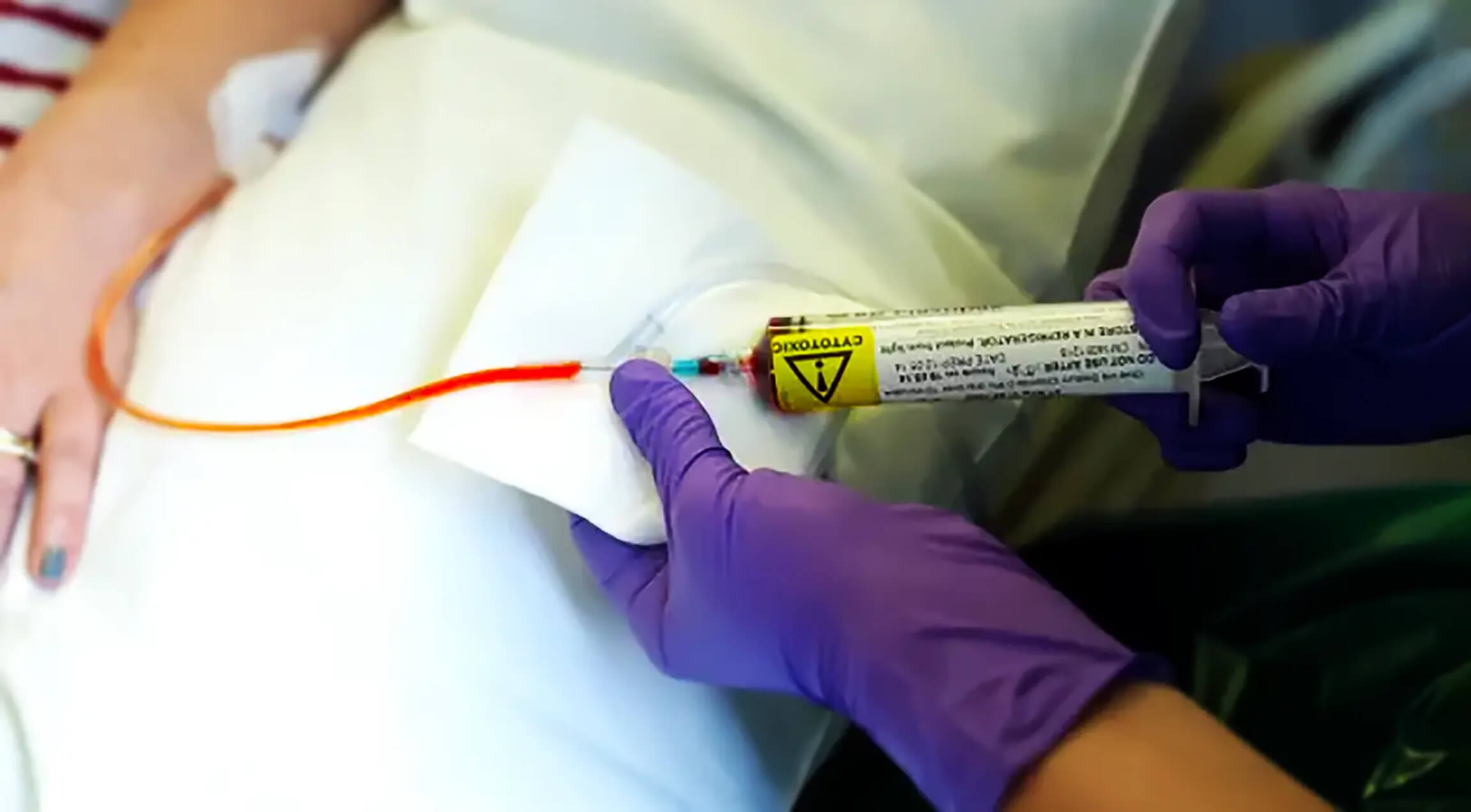
Cancer Choix de l'éditeur Protéine
Protéine Complète : Signalisation de l'IGF-1 dans la Formation du Cancer
Lorsque vous mangez des protéines animales, vous avez quatre fois plus de chances de développer tous les types de cancer. Lorsque vous fumez, vous avez quatre fois plus de chances de développer un cancer du poumon.
Cancer Choix de l'éditeur Protéine
Anatomie du Cancer - Corrélations Entre Les Risques Pour la Santé
Environ 2 % des cancers sont considérés par la médecine comme purement causés par des facteurs génétiques. La même gamme que dans le règne animal. On ne vous a pas dit toute la vérité.
[rank_math_breadcrumb]
Milos Pokimica est rédacteur spécialisé dans la santé et la nutrition et conseiller en sciences nutritionnelles. Auteur d'une série de livres Devenir vegetarien ? Examen des sciences, il exploite également le site Web de santé naturelle GoVeganWay.com
Derniers Articles –

Restriction calorique Longévité
Comment Jeûner : Les Aliments de Jeûne Qui N'interrompent Pas L'Autophagie
L'autophagie. Vous êtes-vous déjà demandé ce qu'il advient des cellules de votre corps lorsqu'elles meurent ou sont endommagées ? S'accumulent-elles et créent-elles des problèmes, ou sont-elles éliminées d'une manière ou d'une autre ? La réponse est que votre corps...

Santé Dentaire La prévention
Sensibilité et Douleur des Dents aux Sucreries : Solution Rapide et Durable
L'huile essentielle de clou de girofle est une solution rapide et facile pour soulager la douleur. C'est un antioxydant puissant et un analgésique qui peut aider à lutter contre les maladies des gencives et les maux de dents.

Les haricots
Haricots Verts : Nutrition et Bienfaits Pour La Santé
Les haricots verts sont pauvres en calories et riches en composés naturels qui peuvent vous aider à contrôler votre glycémie, à réduire votre taux de cholestérol et à lutter contre les radicaux libres.
Régime alimentaire cru Régime végétalien
Peut-on Manger des Champignons Crus : Risques pour la Santé, Nutrition et Sécurité
Les champignons contiennent des toxines sensibles à la chaleur, comme l'hydrazine ou l'agaritine, et des parois cellulaires composées de chitine qui ne peuvent pas être digérées correctement par l'homme.

Régime végétalien
Les Poissons Sont-ils Des Animaux ? Une Perspective Culturelle
Dans certaines cultures, la viande de poisson n'est pas considérée comme de la viande et le poisson est autorisé même pendant le jeûne.
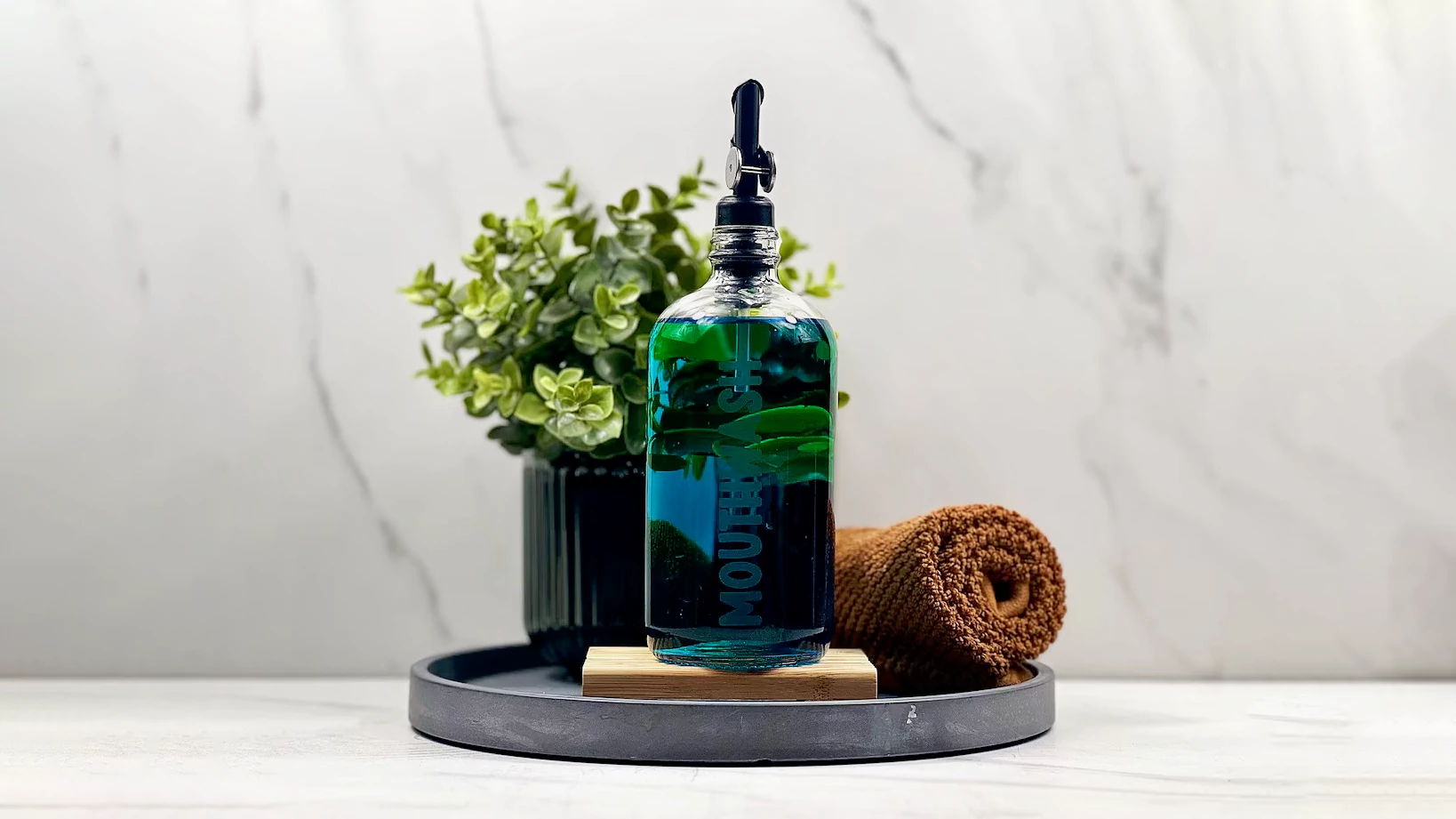
Santé Dentaire La prévention
Rince-bouche Naturel Fait Maison : Éprouvé, Plus Fort et Moins Toxique
Le bain de bouche naturel fait maison est plus puissant que la chlorhexidine, moins toxique et, s'il est avalé, il peut donner des nausées, mais il a aussi une valeur ORAC élevée.
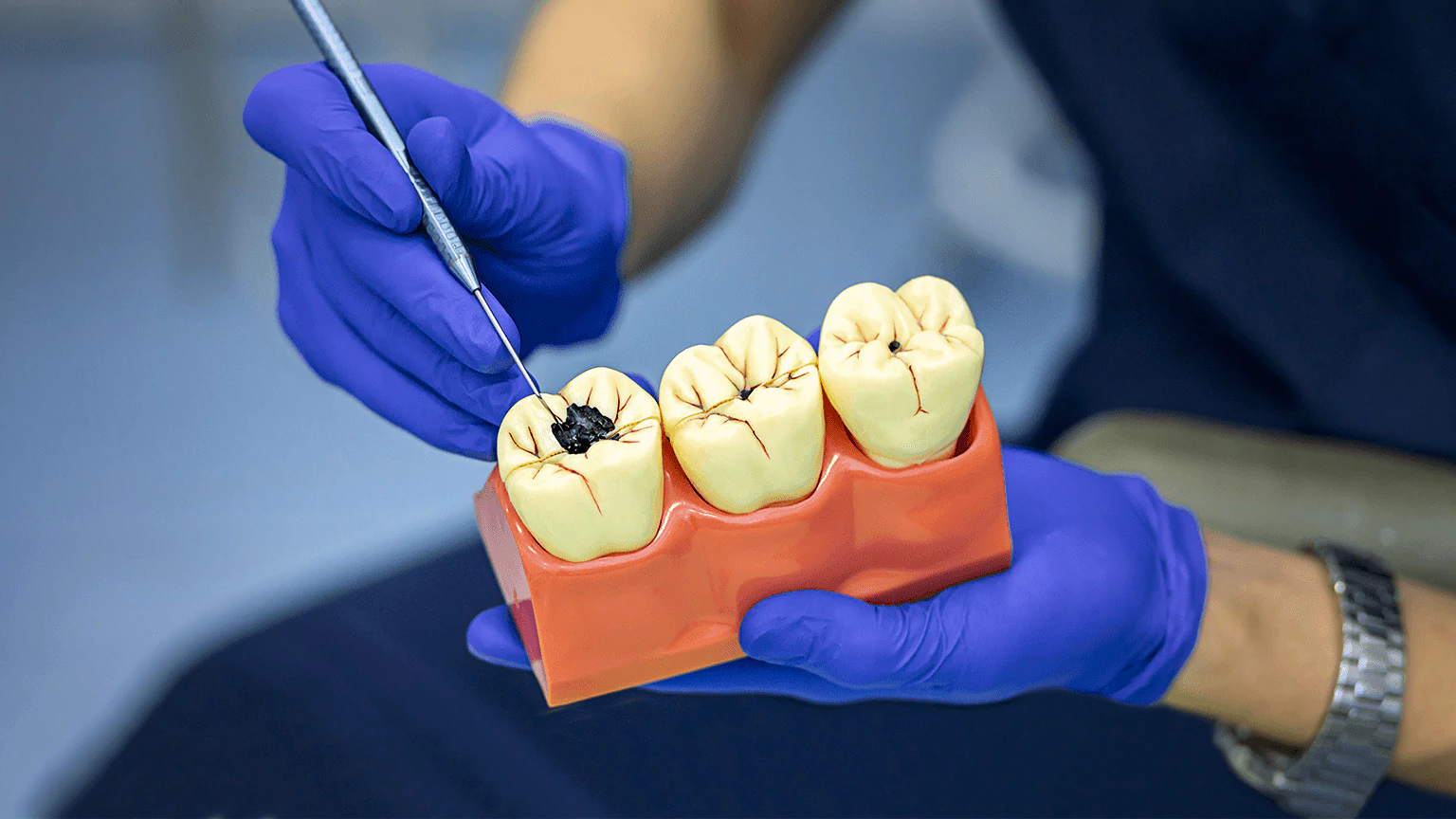
Santé Dentaire La prévention
Comment Arrêter les Caries Dentaires : Symptômes, Causes et Prévention
La consommation de sucre est la principale cause des caries dentaires, associée à des carences en minéraux, notamment en magnésium, zinc, cuivre et oligo-éléments.

Antioxydants Superaliments
Amla : Avantages Prouvés, Nutrition et Signification Clinique
L'amla est l'un des antioxydants les plus puissants au monde, avec un score ORAC de 261 530. Il s'agit d'une riche source de substances phytochimiques qui ont de nombreux effets bénéfiques sur la santé.
Top Des Nouvelles Sur la Santé - ScienceDaily
- A 24-hour fast triggers a surprising repair response in the gutle novembre 8, 2026
Scientists have discovered that fasting for just 24 hours increases a beneficial gut bacterium that helps the intestines regenerate after radiation damage. The preclinical findings could pave the way for new treatments that protect healthy tissue during cancer therapy, potentially without requiring patients to fast.
- MIT scientists turn immune cells into cancer killers inside the bodyle novembre 8, 2026
MIT scientists have developed nanoparticles that reprogram immune cells directly inside the body to attack cancer and harmful immune cells, eliminating tumors and reversing liver damage in mouse experiments. The breakthrough could make powerful immune therapies dramatically simpler and less expensive while opening new possibilities for treating cancer and autoimmune diseases.
- Low testosterone linked to 18% higher risk of dying from cancerle novembre 8, 2026
A major international study tracking more than 26,000 men found that very low testosterone levels were associated with an 18% higher risk of dying from cancer later in life. Surprisingly, testosterone itself showed no clear link to prostate cancer, although two other sex hormones did. Researchers believe low testosterone could be an important early warning sign of future health risks, particularly when levels fall below 8.6 nmol/L.
- Scientists discover hidden brain changes linked to common sleep disordersle novembre 8, 2026
Scientists have discovered that sleep disorders are associated with structural changes in brain regions that control attention, decision-making, and emotions, potentially explaining why disrupted sleep can affect everyday thinking and behavior. The findings, drawn from 57 brain imaging studies, reveal both shared and disorder-specific patterns that could lead to more targeted treatments.
- Stronger flu shot linked to nearly 55% lower Alzheimer’s riskle novembre 8, 2026
A surprising new study suggests that a stronger flu shot could offer older adults significantly greater protection against Alzheimer’s disease. Researchers at UTHealth Houston analyzed nearly 200,000 adults ages 65 and older and found that those who received a high-dose influenza vaccine had a nearly 55% lower risk of developing Alzheimer’s, compared with a 40% reduction previously associated with the standard-dose vaccine.
- Scientists discover a hidden warning sign of cannabis addictionle novembre 8, 2026
A study of more than 17,700 US adults found that people who use cannabis in multiple forms have dramatically higher rates of daily consumption and addiction symptoms than those who stick primarily to one method. Nearly 67% of those who used almost every form met criteria for cannabis use disorder, compared with just 15% of people who mainly consumed edibles.
- Drinking 2–3 cups of coffee a day linked to dramatically lower dementia riskle novembre 7, 2026
Drinking two to three cups of caffeinated coffee daily was linked to a dramatically lower risk of dementia and better cognitive functioning in a study spanning up to 43 years. The benefits appeared regardless of genetic risk, but decaffeinated coffee did not show the same association.
PubMed, #régime-vegan –
- Hospital food retail environment in Poznań, Poland: a one-day audit of protein sources, plant-based options, and cooking methodsle novembre 7, 2026
CONCLUSIONS: Hospital retail food offerings in Poznań were predominantly characterised by animal-based food offerings. These findings provide baseline evidence on food availability within hospital retail settings and may inform future efforts to diversify meal offerings and increase the availability of plant-based options in healthcare institutions.
- Effects of vegetarian or vegan diets on cardiovascular metabolic health in patients with cardiovascular disease: a systematic review and meta-analysisle novembre 5, 2026
CONCLUSIONS: Vegetarian or vegan diets, particularly low-fat vegan diets, may improve lipid profiles by reducing TC and LDL-C in patients with established CVD. No significant benefits were observed for blood pressure or triglycerides. These findings suggest that plant-based dietary interventions may serve as a complementary strategy for the management of cardiometabolic risk factors in CVD patients.
- Food literacy competencies and diet quality in youth adhering to vegan, lacto-ovo-vegetarian, pescatarian or omnivorous diets in Swedenle novembre 5, 2026
CONCLUSIONS: Youth, regardless of dietary practice, may need support to increase their food literacy competencies, including GNK, and consume higher quality diets that better align with the NNR2023 food-based dietary guidelines.
- Food and nutrition literacy, knowledge of potentially critical nutrients, and information sources among vegan women of reproductive age in Austria: A cross-sectional surveyle novembre 3, 2026
BackgroundPlant-based diets have become popular worldwide especially among women and younger people. Recommendations for well-balanced vegan diets are available, but the risk of nutrient deficiencies among strict vegans is of particular concern, especially among children and pregnant or breast-feeding women.ObjectivesThe aim of this study was to compare food and nutrition literacy, knowledge of selected potentially critical nutrients, and sources of nutritional information between a […]
- Food categories contributions to energy and nutrient intakes among youth adhering to vegan, lacto-ovo-vegetarian, pescatarian or omnivorous dietsle octobre 31, 2026
CONCLUSION: The more animal-sourced food categories that were excluded from the diet, the more youths’ relied on cereals and grain products, meat analogs, dairy alternatives (fortified), and legumes as sources of energy and nutrients. Particular attention to vitamin D, B(12), selenium, and calcium (vegans only) and their food sources may be needed when planning vegan and lacto-ovo-vegetarian diets.
Messages Aléatoires -
Antioxydants Choix de l'éditeur ORAC
Régime Riche en Antioxydants : Règles Rénérales et Stratégies
Il existe des stratégies simples et rentables pour optimiser la valeur antioxydante de notre alimentation.
Restriction calorique Longévité
Comment Jeûner : Les Aliments de Jeûne Qui N'interrompent Pas L'Autophagie
L'autophagie. Vous êtes-vous déjà demandé ce qu'il advient des cellules de votre corps lorsqu'elles meurent ou sont endommagées ? S'accumulent-elles et créent-elles des problèmes, ou sont-elles éliminées d'une manière ou d'une autre ? La réponse est que votre corps...
Régime optimal ORAC
Extraction d'Huile à Domicile- La Technique Secrète de la Densité Nutritive
La transformation des aliments (extraction d'huile à domicile) peut également être utilisée en sens inverse pour augmenter la densité nutritionnelle et le profil des aliments.

Antioxydants Inflammation
Le Rôle des Antioxydants Dans la Dépression et l'Anxiété : La Pièce Manquante
Le stress oxydatif avec inflammation chronique du cerveau est associé au développement de troubles neuropsychiatriques, notamment la dépression majeure et l'anxiété.

Régime alimentaire cru
Alimentation Crue - La Perspective Evolutive
La croyance de base dans la communauté des aliments crus est qu'un régime alimentaire cru est le mode de vie le plus naturel et le plus sain. Que nous dit la biologie évolutive?

Choix de l'éditeur Obésité
Hyperphagie Boulimique et Régulation Hormonale: la Faim Emotionnelle
Durant toute notre évolution, nous étions comme n'importe quelle autre espèce sur cette planète, en constante faim et en quête de nourriture. La suralimentation est un exemple de mauvaise adaptation.

Choix de l'éditeur Régime paléo Régime végétalien
Taille du Cerveau, Intelligence et Consommation de Viande- L'argument Végétalien
La combinaison d'une certaine quantité de viande fourragée au régime à prédominance végétalienne n'est pas devenue une force pivot dans l'émergence de l'intelligence humaine et de la taille du cerveau.
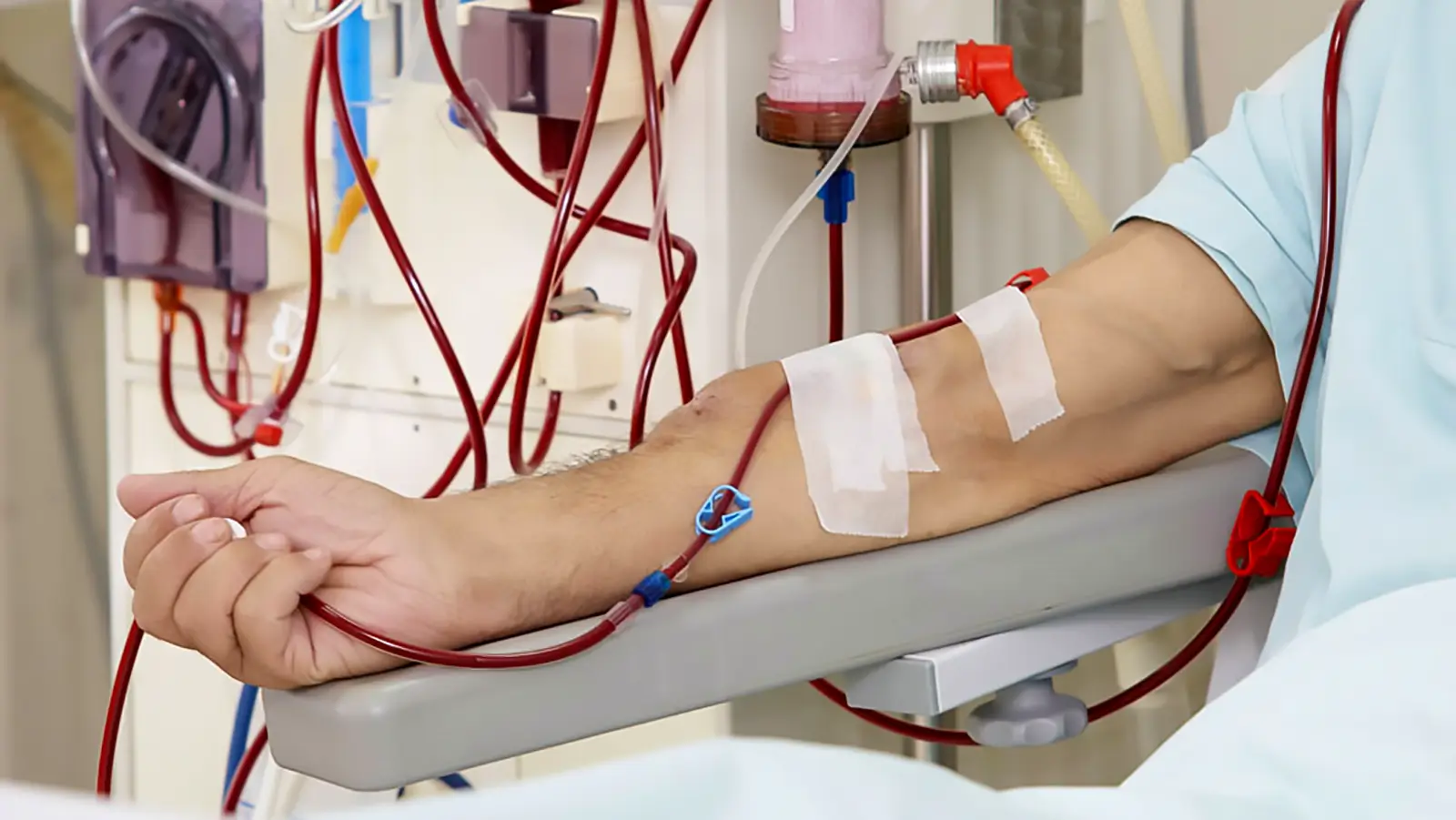
Choix de l'éditeur Régime optimal Protéine
Régime Riche en Protéines- Corrélations des Risques Pour la Santé
Scarcity is the rule of protein in nature. In evolutionary terms, anthropologists have proven that hominins lived an average of 15 to 25 grams of protein a day. In the modern western type of high-protein diet we would consume that…
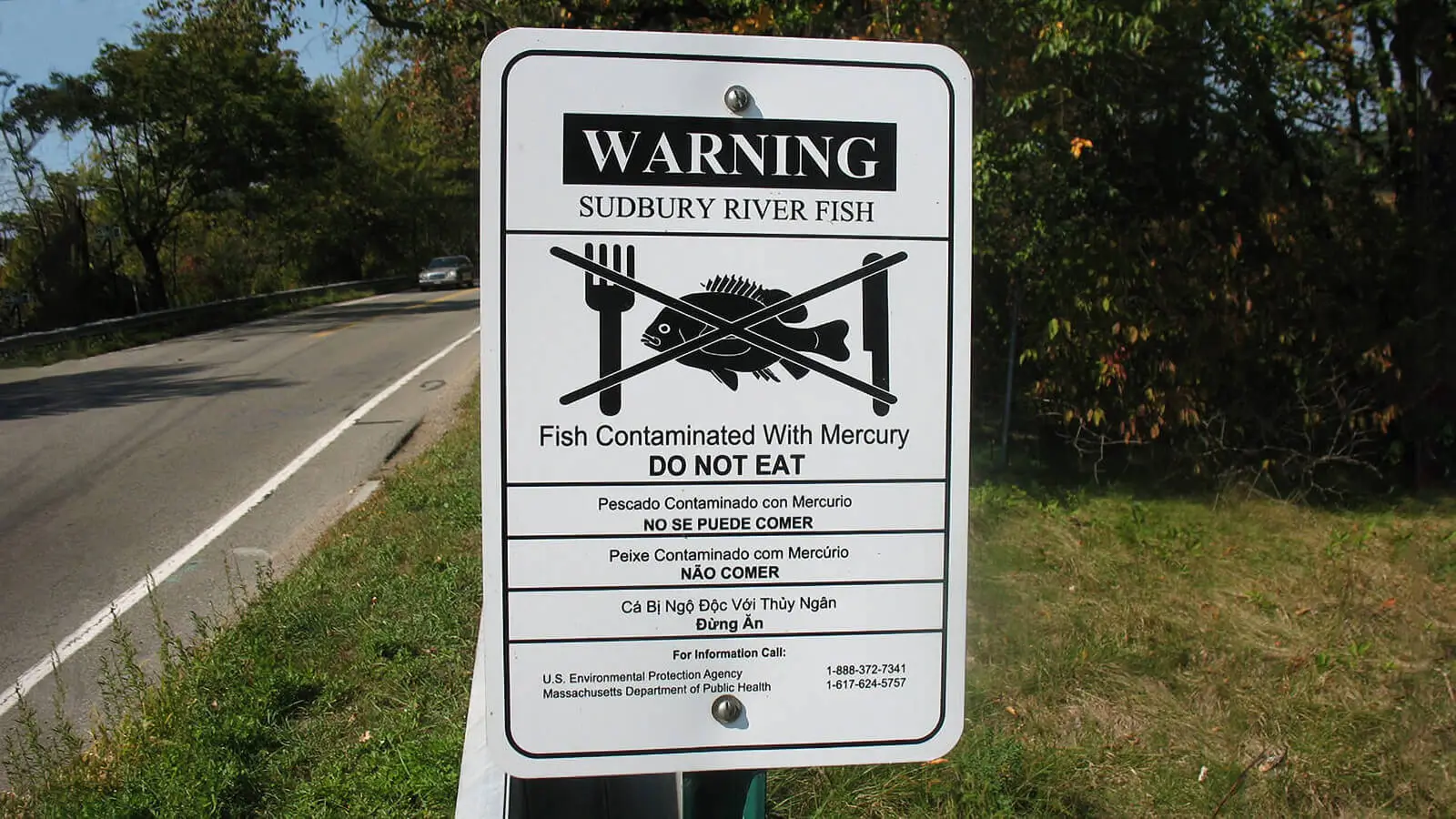
Toxicité
Mercure - Neurotoxine du Poisson
Le mercure est une toxine industrielle et la substance la plus neurotoxique connue. Le plancton l'absorbera de l'eau de mer et initiera la bioaccumulation dans la chaîne alimentaire.

Café Toxicité
Avantages du Café – Pas Sans Risques
Pensons-nous que la caféine est bonne pour notre cerveau ou mauvaise ou neutre ?
Que fait la caféine réelle?


Postes en Vedette -

Choix de l'éditeur Obésité
Hyperphagie Boulimique - La Psychologie de la Faim
Dans la nature, il n'y a ni sucre raffiné ni graisse. Notre cerveau n'avait jamais été exposé à une combinaison des deux tout à la fois nous forçant à l'hyperphagie boulimique.
Choix de l'éditeur Phytochimiques
Photochimie : Comprendre les Bases
Chaque phytochimique qui existe a une action biologique dans le corps humain. Chacun parmi des millions de composés phytochimiques différents.

Choix de l'éditeur La prévention Régime végétalien
Étude sur la Chine- L'argument Végétalien
Une étude chinoise a montré qu'il n'y a pas de maladie cardiaque, de cancer ou de diabète dans les communautés rurales sous-développées du monde avec des régimes végétaliens à base d'amidon.

Médecine allopathique Cancer Choix de l'éditeur
Cancer, The Forbidden Cures-Rife Machine, Revue Historique
Le taux de récupération des patients atteints d'un cancer non traitable et déclarés en phase terminale en utilisant la technologie de résonance Rife Machine était de 100 %.
Choix de l'éditeur La prévention Toxicité
Toxicité Environnementale- C'est Juste Une Chaîne Alimentaire
La toxicité environnementale est la bioaccumulation de toxines. Les organismes sont des filtres. Mais il existe un autre processus encore pire appelé bioamplification dans la chaîne alimentaire.

Cancer Choix de l'éditeur Toxicité
Pesticides Dans les Aliments, Exposition Dans le Régime Alimentaire Américain Standard- 80 % de Viande
La plupart des pesticides et en particulier les métaux lourds et autres polluants toxiques que nous obtenons proviennent de la viande. Plus de 80 % de l'exposition aux pesticides dans le régime alimentaire américain standard provient de produits d'origine animale, et non de fruits ou de légumes.
Antioxydants Choix de l'éditeur ORAC
Comprendre les Valeurs ORAC : La Teneur en Antioxydants des Aliments
Lorsque votre principale source d'antioxydants est le café, vous savez que vous avez un sérieux problème.
Diabète Choix de l'éditeur
Causes du Diabète et Graisses Saturées- L'argument Végétalien
À mesure que le niveau de graisse dans le sang augmente, la capacité du corps à éliminer les gouttes de sucre. L'une des causes du diabète est notre mauvaise adaptation à un apport important en matières grasses
Choix de l'éditeur Régime végétalien
Les Carences en Nutriments Dans le Régime Végétalien : Stratégies de Prévention
Il existe neuf carences nutritionnelles courantes à l'échelle de la population qui affectent les personnes qui suivent un régime à base de plantes. Si elles ne sont pas corrigées à temps, certaines déficiences ont des conséquences terribles et incurables.

Choix de l'éditeur Régime optimal Protéine
Besoins en Protéines - Une Vérité Qui Dérange
Lorsque des études anthropologiques ont montré que les hominines vivaient en moyenne de 15 à 20 grammes de protéines par jour, il y a eu un soi-disant « grand fiasco des protéines » dans les années 1970.
Dernières Nouvelles de PubMed, #alimentation végétale –
- Hospital food retail environment in Poznan, Poland: a one-day audit of protein sources, plant-based options, and cooking methodspar Matylda Kręgielska-Narożna le novembre 7, 2026
CONCLUSIONS: Hospital retail food offerings in Poznań were predominantly characterised by animal-based food offerings. These findings provide baseline evidence on food availability within hospital retail settings and may inform future efforts to diversify meal offerings and increase the availability of plant-based options in healthcare institutions.
- Symbiont-Derived Key Innovations Across the Diversity and Diets of Herbivorous Insectspar Jacob A Russell le novembre 7, 2026
With prodigious biomass and diversity, herbivorous insects are among the world’s most successful animals. It is widely believed, however, that some plant-based diets do not meet the needs of insect metabolism. Microbial symbionts may balance such deficits through diverse biochemistry. Here, we consider whether obligate nutritional symbioses between insects and microbes support large portions of insect herbivore diversity. In doing so, we assess the evidence that these highly integrated…
- NMR metabolomic profiles in white British and British Indian vegetarians and non-vegetarians in the UK Biobankpar Qiaoye J Wang le novembre 7, 2026
CONCLUSION: Marked differences in metabolite profiles across diet groups were observed in both ethnic groups, reflecting variations in fatty acid, amino acid, and lipid intake and metabolism, which may provide insights into metabolic pathways linking diets to health outcomes.
- Effects of Wall-broken yeast powder on gut microbiota and serum metabolome in captive forest musk deer (Moschus bere-zovskii)par Yongjiang Wu le novembre 6, 2026
Forest musk deer (Moschus berezovskii), a nationally protected species, has experienced a rapid population decline, highlighting the need to improve captive breeding strategies. Captive individuals are more susceptible to gastrointestinal disorders than wild individuals, making dietary regulation important for intestinal health. Wall-broken yeast (BWY) powder, has attracted increasing attention as a functional feed additive due to its potential roles in regulating intestinal health, microbial…
- From detection to decision: molecular, genomic, and AI innovations for managing Ganoderma boninense in oil palmpar Qudrat Ullah le novembre 6, 2026
Ganoderma boninense causes basal stem rot (BSR) in oil palm, resulting in substantial economic losses, particularly for smallholders who contribute approximately 40% of global production. This review synthesizes advances in molecular diagnostic techniques (qPCR, LAMP), whole-genome sequencing of resistant Elaeis guineensis genotypes, and AI-driven remote sensing to enhance understanding of G. boninense pathobiology. Soilborne mycelia of the pathogen can persist for more than 10 y. […]
- Dietary exposure to neonicotinoids of the Hong Kong population through a total diet studypar Stephen W C Chung le novembre 6, 2026
Neonicotinoids (neonics) are a class of insecticides with a similar structure to nicotine and have been used in agriculture since the late 1990s, gradually replacing organophosphorus pesticides and carbamates as the most widely used insecticides. Dietary exposure assessment of the Hong Kong adult and younger populations to neonics was included in the second Hong Kong Total Diet Study (TDS). A total of 187 commonly consumed food items were collected and prepared “as consumed”. A total of 374…