







Un produit chimique a rendu l'industrie si heureuse. C'est un produit chimique qui fait tout ce que font les excitotoxines, mais contrairement au MSG, il est doux au goût. C'est un produit chimique connu sous le nom d'aspartame (Nutra Sweet).
Milos Pokimica
Écrit par : Milos Pokimica
Examiné Médicalement Par : Dr. Xiùying Wáng, M.D.
Mise à jour le 30 septembre 2023Lorsque l'industrie enlève la graisse du produit, elle doit ajouter quelque chose pour rendre ce produit à nouveau savoureux. Ce qu'ils font s'ils enlèvent la graisse, c'est qu'il n'y a rien dans le produit, donc la solution est d'ajouter quelque chose pour augmenter le goût, généralement du sucre. Si le produit n'est pas sucré, le sucre n'est pas une option. Ensuite, ils ajouteront du MSG et du sel. La réponse dans le cerveau des excitotoxines compensera le sucre manquant. Cependant, le problème se pose alors.
Que rajouterez-vous si un produit doit être sucré ?
Que faire si le produit doit être sans calories ajoutées ou simplement sans sucre ajouté mais toujours sucré ? Dans ce cas, ils peuvent ajouter d'autres édulcorants artificiels, mais cela ne déclenchera pas le cerveau de la même manière que le sucre, donc ils ont un problème. L'ajout d'édulcorants artificiels réguliers conduira à des résultats insatisfaisants pour diverses raisons que j'ai déjà déguisées ici (Édulcorants Artificiels- Comprendre les Bases). Ils ont besoin de quelque chose pour vraiment activer la signalisation de la dopamine dans le cerveau comme le fait le sucre, donc le goût n'est que la moitié de l'équation.
Le problème que l'excitotoxine au goût sucré résoudra.
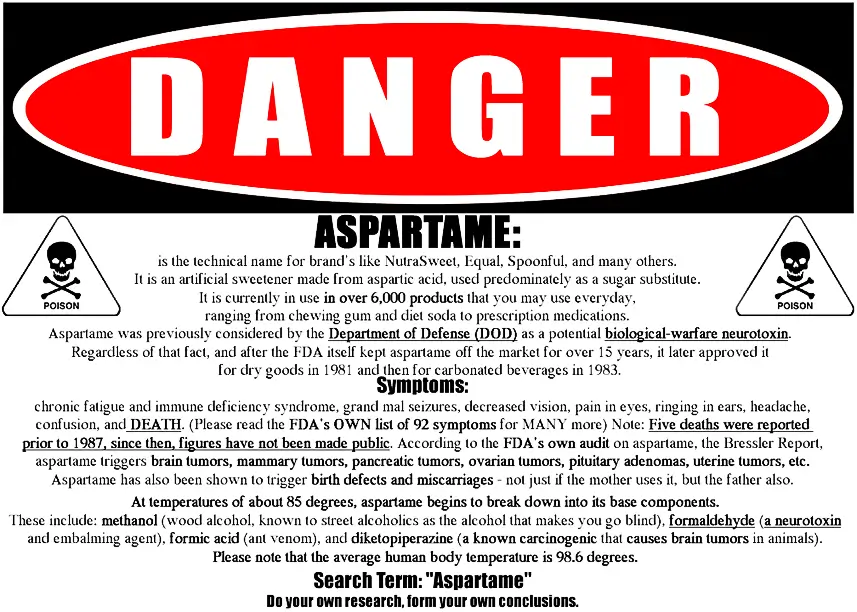
Considérez l'aspartame comme un substitut sucré au MSG. Dans les cas où ils ont besoin d'éliminer à la fois le sucre et les graisses, ils peuvent ajouter des excitotoxines pour obtenir l'effet souhaité. C'est pourquoi la soupe MSG est savoureuse sans aucune calorie. C'est pourquoi le coca light est savoureux sans aucune calorie. Ils y ajouteront des stimulants comme la caféine et des excitotoxines comme l'aspartame qui ont un goût sucré et stimuleront le cerveau en même temps, de sorte que la réponse du cerveau sera comme si vous aviez mangé quelque chose qui contient en fait du sucre. Boire des sodas light peut créer une dépendance à cause de cet effet de simulation.
Lorsque nous utilisons un stimulant, nous devenons excités. En réagissant avec notre système dopaminergique, le stimulant nous procure du plaisir et de l'euphorie qui nous motivent à consommer à nouveau le même stimulant afin d'éprouver une sensation de récompense répétée (un processus identifié comme un renforcement positif).

Un autre aspect de cela, connu sous le nom de renforcement négatif, est l'arrêt soudain des stimulants addictifs qui peuvent entraîner des envies, qui sont essentiellement le sentiment de vouloir éviter l'inconfort qui se développe une fois que le high artificiel du stimulant a disparu.

Dans ces deux processus, nous en voulons plus. En fait, la mémoire de la dépendance à la cocaïne réside dans le récepteur du glutamate (Mao et al., 2013). En réponse à l'exposition au médicament, ces récepteurs dans les neurones présentent des changements d'expression marqués et dynamiques. De nouvelles preuves les lient au remodelage des synapses excitatrices et à la recherche persistante de drogue. Le niveau élevé d'expression des récepteurs du glutamate mGluR7 dans le circuit de récompense limbique implique son rôle dans la toxicomanie. En fait, des preuves associent ce récepteur aux effets addictifs des psychostimulants, de l'alcool et des opiacés. C'est le glutamate comme le glutamate dans le MSG.
En réponse à l'administration opérante de drogues addictives courantes, telles que les psychostimulants (cocaïne et amphétamines), l'alcool et les opiacés, les mGluR limbiques du groupe III subissent des adaptations drastiques pour contribuer au remodelage durable des synapses excitatrices et suppriment généralement le comportement de recherche de drogue. Par conséquent, une mutation avec perte de fonction (inactivation) des sous-types individuels de récepteurs du groupe III favorise souvent la recherche de médicaments (Mao et al., 2013).
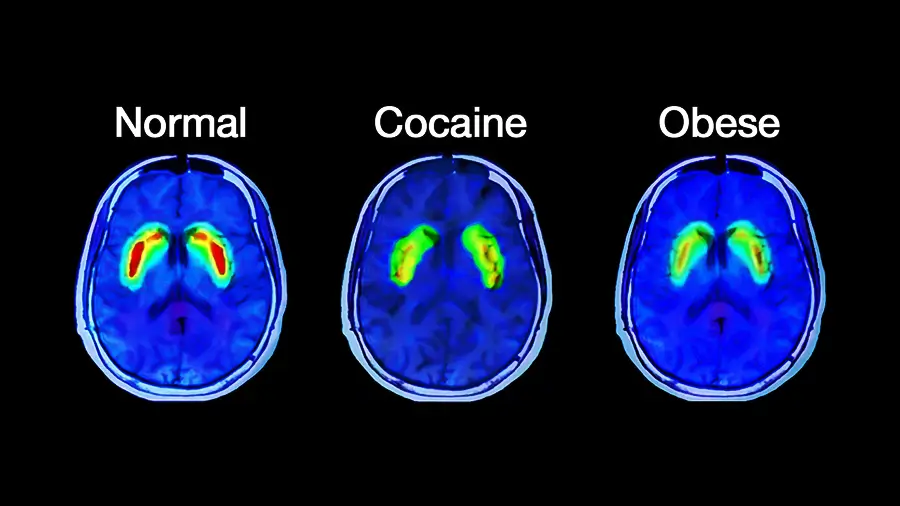
C'est exactement pourquoi l'aspartame, un produit chimique aux propriétés très uniques, est utilisé même s'il s'agit de l'un des produits chimiques les plus toxiques et neurotoxiques qui existent. Il est tout à fait unique dans sa forme qui est à la fois douce et a des caractéristiques d'excitotoxicité en même temps, donc pour le moment, il est irremplaçable. Les effets secondaires que ce produit chimique peut avoir sur notre santé sont impossibles à corréler légalement avec les entreprises qui l'utilisent. Il a un effet inducteur de dopamine sur le cerveau et, combiné à la caféine qui a le même effet, peut déclencher avec succès un comportement addictif, en particulier chez les enfants. C'est pourquoi le coke zéro l'a utilisé par exemple et non quelque chose de plus sain comme l'érythritol. Toutes les entreprises aujourd'hui le savent et elles feront tout ce qu'il faut pour garder l'aspartame en sachant très bien que vous ou disons la plupart de la population, 99 % ne lisent jamais les étiquettes mais lisent néanmoins des articles comme celui-ci. Et cela inclut les femmes enceintes, les enfants, les personnes atteintes de cancer, etc. Même l'histoire de la substance est si révélatrice pour comprendre ce qui se passe en réalité derrière le marketing et la propagande.
En 1965, alors qu'il travaillait sur un médicament contre les ulcères, James Schlatter, chimiste chez GD Searle (une filiale de Pfizer), a accidentellement découvert l'aspartame, une substance 180 fois plus sucrée que le sucre mais sans calories. Il recristallise l'aspartame dans l'éthanol. Le composé s'est répandu à l'extérieur du flacon et une partie a collé à ses doigts. Il l'oublia et se lécha les doigts pour ramasser un morceau de papier et remarqua un goût sucré irrésistible.

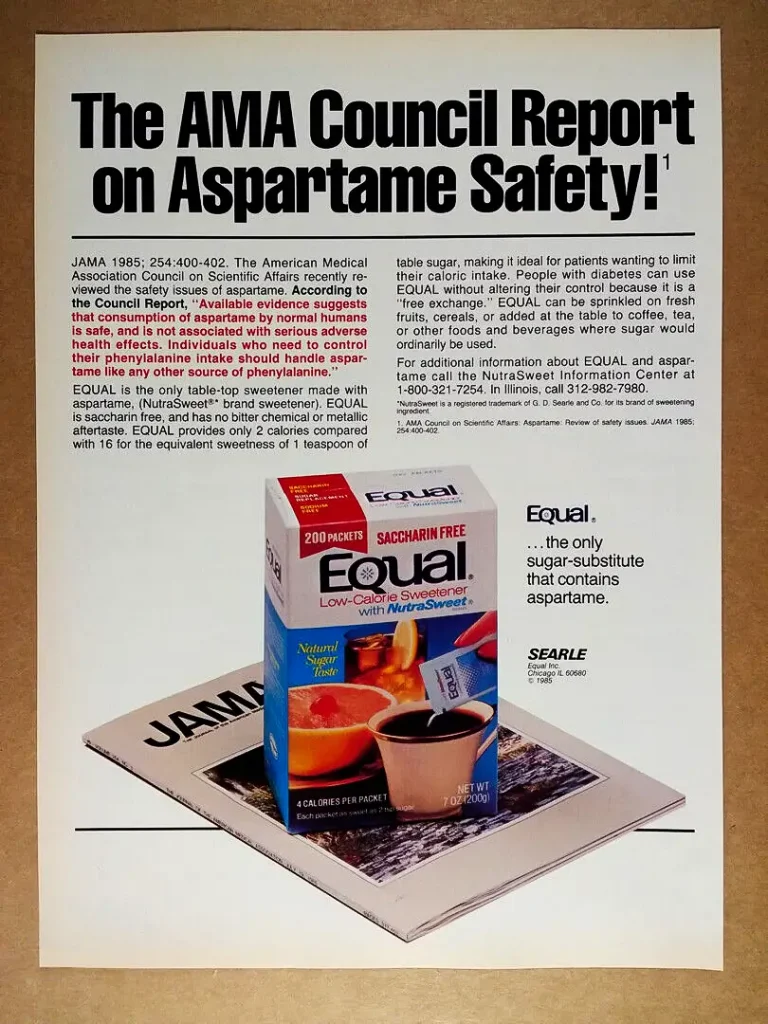
En 1967, Searle commence les tests de sécurité sur l'aspartame qui sont nécessaires pour demander l'approbation de la FDA des additifs alimentaires. Sept bébés singes ont reçu de l'aspartame mélangé à du lait. L'un est mort après 300 jours. Cinq autres (sur sept au total) ont eu des crises de grand mal. Les résultats ont été retenus par la FDA lorsque GD Searle a soumis ses demandes initiales. Pourquoi ont-ils mélangé de l'aspartame avec du lait ? Parce que le lait ralentira sa digestion dans une certaine mesure dans l'espoir qu'il ne submergera pas le cerveau en peu de temps et ne causera pas de dommages. Le plus gros problème était qu'ils essayaient de cacher les résultats. Quelques années plus tard, les dirigeants de Searle Company avaient créé la note de politique interne dans laquelle ils décrivaient différentes tactiques psychologiques que l'entreprise devrait utiliser pour amener la FDA dans un "esprit subconscient de participation" avec eux sur l'aspartame et amener les régulateurs de la FDA dans "l'habitude". de dire oui. À cette époque, il n'y avait plus d'études non financées par l'industrie.
Le neuroscientifique Dr John Olney (cette recherche pionnière sur le glutamate monosodique était responsable de son retrait des aliments pour bébés) en a fait quelques-uns et a déjà informé la société Searle que ses études ont montré que l'acide aspartique (l'un des ingrédients de l'aspartame ) provoque des trous dans le cerveau des bébés souris. Mais en 1973, après avoir dépensé des dizaines de millions de dollars pour effectuer des tests de sécurité, Searle Company a demandé l'approbation de la FDA et a soumis 11 études pivots, et a réalisé 113 études à l'appui de la sécurité de l'aspartame dans les années suivantes. Un an plus tard, la FDA accorde à l'aspartame sa première approbation pour une utilisation restreinte dans les aliments secs.
La même année, deux hommes, Jim Turner et le Dr John Olney, ont déposé les premières objections contre l'approbation de l'aspartame. Deux ans plus tard, leur pétition a déclenché une enquête de la FDA sur les pratiques de laboratoire du fabricant d'aspartame, GD Searle. L'enquête a révélé que les procédures de test de Searle n'étaient pas scientifiques, pleines d'erreurs et de données «manipulées». Les chercheurs rapportent qu'ils "n'avaient jamais rien vu d'aussi mauvais que les tests de Searle". La société GD Searle en croisade pour obtenir l'approbation a mené une ligne d'études sur les animaux. Quand ils ont soumis cela à la FDA, il y avait des questions sur les études.
Une façon dont ils ont essayé de manipuler les données était qu'ils ont montré dans les études qu'il n'y avait pas beaucoup plus de tumeurs dans le groupe test que dans le groupe témoin. Lorsque certains des neuroscientifiques qui travaillent pour la FDA ont examiné les données, ils ont vu que c'était correct, mais il y avait d'autres problèmes. Les deux groupes avaient des taux de tumeurs significativement plus élevés que la moyenne normale, en particulier pour les tumeurs cérébrales. Cela peut se produire lorsque quelqu'un essaie de manipuler des données et de représenter certains des rats témoins atteints de tumeurs comme faisant partie du groupe témoin. Cela réduira le taux de tumeurs dans un groupe de test, cela l'augmentera dans le groupe de contrôle, et à la fin, ils peuvent dire que cela ne cause aucune tumeur ou quoi que ce soit, mais alors le groupe de contrôle et le groupe de test vont ont des taux de tumeurs significativement plus élevés que les moyenne normale.
Ils ont donc demandé que des recherches soient effectuées par le Bureau des aliments, qui était le précurseur de la FDA. Le Dr Jerome Bressler était responsable du groupe qui a examiné les recherches effectuées par Searle. Dans son rapport, il a déclaré qu'il y avait des interprétations erronées des données et qu'il s'agissait de la pire recherche au monde. Le dossier note que 98 des 196 animaux sont morts au cours d'une des études de Searle et n'ont été autopsiés que plus tard. De nombreuses erreurs et divergences sont relevées. Par exemple, un rat a été enregistré vivant, puis mort, puis vivant, puis mort à nouveau. Ils ont découvert que certains des animaux qui sont morts après que les scientifiques de l'aspartame Searle n'aient fait l'autopsie qu'un an plus tard. Après cette période, la chair était pétrifiée et il n'y avait aucun moyen possible de faire une autopsie. Cependant, ils ont déclaré qu'ils avaient fait des autopsies et que les animaux sont normaux. Ils coupaient les tumeurs et disaient que les animaux étaient en bonne santé. Ils avaient des tissus animaux qui contenaient des tumeurs évidentes qui étaient normales. L'atrophie testiculaire n'a pas été notée. Là où un effort pour dissimuler les effets négatifs pour obtenir l'approbation. S'ils faisaient de la science normale, l'aspartame ne serait pas approuvé.
La FDA a officiellement demandé au bureau du procureur des États-Unis d'entamer des procédures devant un grand jury pour déterminer si des accusations devraient être portées contre Searle pour conclusions délibérément trompeuses et "dissimulation de faits matériels et fausses déclarations" dans les tests de sécurité de l'aspartame.
C'était la première fois dans l'histoire de la FDA qu'ils demandaient une enquête criminelle sur un fabricant.
Alors que l'enquête du grand jury est entreprise, Sidley & Austin, le cabinet d'avocats représentant Searle, avait entamé le travail de négociations avec le procureur américain chargé de l'enquête, Samuel Skinner. Samuel Skinner quittera le bureau du procureur américain plus tard cette année-là et prendra un emploi au sein du cabinet d'avocats de Searle, Sidley and Ostin. Dans le même temps, GD Searle va embaucher l'éminent initié de Washington Donald Rumsfeld en tant que nouveau PDG. Un ancien membre du Congrès et secrétaire à la Défense de l'administration Ford. Oui, ce Donald Rumsfeld. Rumsfeld a été nommé secrétaire à la Défense pour la deuxième fois en janvier 2001 par le président George W. Bush.

La médaille que Rumsfeld a reçue en 2004 était la médaille présidentielle de la liberté. "Freedom" propose le droit d'utiliser vos associés influents à Washington pour soutenir la substance dangereuse de votre entreprise pour la consommation humaine et gagner un gros bonus en sortant. Cela signifie également que vous pouvez larguer des bombes sur d'autres pays. Cela signifie également que vous pouvez soudoyer le procureur américain chargé de l'enquête.
Après le retrait et la démission de l'avocat américain Skinner, l'enquête du grand jury de Searle a connu des blocages importants pendant si longtemps que le délai de prescription des accusations d'aspartame était épuisé..
L'assistant de l'avocat américain William Conlon, qui a été affecté à l'enquête du grand jury, a laissé expirer le délai de prescription. Il a été embauché quinze mois plus tard par le même cabinet d'avocats Searl Sidley & Austin.
L'enquête du grand jury a été abandonnée.
Deux ans plus tard, en 1979, la FDA a créé une commission d'enquête publique pour statuer sur les problèmes de sécurité entourant NutraSweet. La conclusion de la commission d'enquête publique était que l'aspartame ne devrait pas être approuvé tant que des recherches supplémentaires n'auront pas été effectuées. Le conseil a déclaré que :
"Il n'a pas été présenté de preuve de certitude raisonnable que l'aspartame est sans danger pour une utilisation en tant qu'additif alimentaire."
En 1980, la FDA interdit l'utilisation de l'aspartame après avoir mené trois études scientifiques autonomes sur l'édulcorant.
Quand quelqu'un veut dire que tout cela n'est qu'un complot, rappelez-lui que la FDA a déjà interdit la substance même avec tout le lobbying derrière. Cela en dira long sur la toxicité de l'aspartame. Il a été conclu que l'un des principaux effets sur la santé était qu'il avait un risque élevé d'induire des tumeurs cérébrales. Nous devons également garder à l'esprit qu'à cette époque, la FDA n'était pas tenue d'examiner les effets sur le cerveau des additifs alimentaires. Aucune étude n'a été réalisée pour examiner l'effet de l'aspartame sur les effets neurologiques à long terme ou même à court terme. Les études sur le cancer se sont transformées en tumeurs cérébrales, mais ce sont des études sur le cancer, pas des études sur le cerveau. Les études sur le cancer étaient les principales et les seules qu'ils aient jamais étudiées.
En 1981, Ronald Reagan a prêté serment en tant que président des États-Unis. Son équipe de transition comprenait Donald Rumsfeld, PDG de GD Searle. Rumsfeld a nommé le Dr Arthur Hull Hayes Jr. au poste de nouveau commissaire de la FDA. Même avant cela, la première chose que Ronald Reagan a faite lorsqu'il a prêté serment en tant que président a été de suspendre l'autorité du commissaire de la FDA à prendre des mesures.
La première chose que Regan a faite, pas la deuxième ou la troisième, mais la première chose a été de pousser pour l'approbation de ce produit chimique. Il y avait évidemment une crainte que le commissaire fasse quelque chose au sujet de l'aspartame avant de quitter ses fonctions. Cela rendra les choses plus difficiles pour eux, alors Regan a suspendu l'autorité du commissaire de la FDA jusqu'à ce qu'ils puissent en élire un nouveau dans un mois environ.
Au cours de ce mois, l'ancien commissaire de la FDA a été empêché de prendre des mesures. Il n'a pas fallu longtemps au nouveau commissaire de la FDA choisi par Donald Rumsfeld, PDG de GD Searle pour approuver la substance chimique fabriquée par GD Searle.
Le nouveau commissaire de la FDA a sélectionné une commission scientifique de 5 personnes pour évaluer la décision de la commission d'enquête. Il n'a fallu que quelques semaines lorsqu'on lui a présenté tous les effets toxiques de la substance pour que le panel se prononce 3 contre 2 en faveur de l'interdiction de l'aspartame.
Hull a alors opté pour une tactique différente. Il a nommé un 6e membre au conseil d'administration, ce qui a créé une égalité dans le vote, 3-3. Puis Hull lui-même a décidé de rompre l'égalité et d'approuver l'utilisation personnelle de l'aspartame. Hull a ensuite quitté la FDA sous plusieurs allégations, a servi brièvement au New York Medical College en tant que couverture, puis a pris un poste de consultant (1000 $ par jour) pour ne rien faire avec Burston-Marsteller. Burston-Marsteller est la principale société de relations publiques de Monsanto et de GD Searle. Depuis lors, il a disparu et n'a jamais parlé publiquement de l'aspartame. Sept des personnes clés qui ont pris des décisions dans tout ce processus qui ont fait passer l'aspartame tout au long du processus ont fini par vivre et obtenir un nouvel emploi pour certaines des industries utilisatrices de Nutra Sweet. En 1985, Monsanto a décidé d'acheter le brevet de l'aspartame à GD
Également à partir du milieu des années 1980, la FDA a dissuadé et en fait empêché le Programme national de toxicologie de faire des recherches à long terme sur le cancer de l'aspartame. Ce qui restait, ce sont des centaines d'études fondées par l'industrie qui n'ont rien montré, un taux de sécurité de 100 %, et plus de 90 études réalisées de manière indépendante, dont plus de 90 % ont montré un risque accru de cancer et de nombreux autres effets indésirables. Des études scientifiques ont été menées avec des conclusions allant de "sûr dans toutes les conditions" à "dangereux à n'importe quelle dose".
Il y a une augmentation bien documentée des taux d'incidents de tumeurs cérébrales en 1985 qui sont restés élevés à ce jour. L'Institut national du cancer a enregistré une augmentation impressionnante le taux de cancer primaire du cerveau depuis 1985. À cette époque, cette tendance était singulièrement attribuée à des procédures de numérisation et de diagnostic plus innovantes. Le problème est que des appareils de balayage du cerveau adéquats étaient largement disponibles pendant au moins dix ans avant 1985. De plus, les incidents d'autres formes de cancers en dehors du cerveau sont restés les mêmes et, dans certains cas, ont diminué. L'aspartame était entièrement commercialisé en 1983. Déjà en 1984, il y avait une augmentation de 10 % du taux de cancer du cerveau aux États-Unis et l'incidence du lymphome cérébral, un type de tumeur cérébrale agressive, a bondi de 60 %.
Dans l'intestin, l'aspartame est décomposé pour libérer du méthanol et deux acides aminés, la phénylalanine et l'aspartate. Environ 50 % de celui-ci est de l'acide aspartique, 40 % de la phénylalanine et 10 % de l'alcool de bois ou du méthanol.
Le méthanol est ensuite métabolisé en formaldéhyde.
Vous connaissez peut-être le formaldéhyde en tant que Liquide d'embaumement. Le corps ne peut pas se débarrasser du formaldéhyde. N'importe quelle quantité stockée par le corps. L'industrie a fait grand cas de la présence d'un groupe méthyle dans tous les fruits et légumes. Tout ce que nous mangeons contient des groupes méthyle, donc manger du méthanol dans l'aspartame n'est pas grave et les concentrations de formaldéhyde en comparaison sont minuscules. La quantité de formaldéhyde que nous consommons à partir des fruits est bien supérieure à la quantité que nous pourrions obtenir de l'aspartame. Vous entendrez cela avec n'importe quel médecin ou recherche conçu pour défendre l'utilisation de l'aspartame. Mais encore une fois, ils ne disent pas toute la vérité.
Lorsque le corps métabolise l'aspartame, vous vous retrouvez avec une petite quantité de formaldéhyde, mais ce formaldéhyde est sous forme libre.
Lorsque vous mangez des fruits, vous consommez plus de méthanol, mais ce méthanol est lié à la pectine. Les humains n'ont pas l'enzyme pour décomposer la pectine. Nous sommes incapables de séparer le méthanol de la pectine. Il traverse le corps sans faire aucun dommage. Même s'il y a plus de méthanol dans les fruits et légumes, en réalité ce méthanol n'est pas pertinent. Dans l'aspartame, le méthanol libre, puis le formaldéhyde libre, même en quantités infimes, sont dangereux en raison de leur effet toxique cumulatif. Outre le méthanol, dans la nature, nous consommons la même quantité d'éthanol dans les fruits ou les légumes. Il y a du méthanol et de l'éthanol dans les fruits, et ils se neutralisent.
Lorsque GD Searle a fait une expérience avec des singes, l'aspartame donne à ces singes des crises de grand mal. Les singes ont une réaction plus élevée à l'éthanol que les humains. Alcool régulier comme le vin. En revanche, ils ont une résistance très élevée au méthanol. Beaucoup plus élevé que les humains. Même avec une résistance élevée, et même s'ils étaient nourris avec de l'aspartame avec du lait, ils avaient toujours des convulsions, et un est décédé d'un arrêt cardiaque causé par une stimulation excessive du système nerveux.
Outre l'acide méthanol aspartique est un il a été démontré que l'excitotoxine et la phénylalanine traversent la barrière hémato-encéphalique, et c'est un précurseur de la noradrénaline (adrénaline dans le cerveau).
La phénylalanine est naturellement présente dans le cerveau. Ce n'est pas si mal, mais si nous avons un niveau anormalement élevé, cela peut être très mauvais. Il existe un trouble médical qui touche 1 personne sur 10 000, connu sous le nom de PCU (Phénylcétonurie). Il s'agit d'une surabondance de phénylalanine dans le cerveau en raison de l'incapacité du corps à la traiter. Si vous ajoutez de la phénylalanine à quelqu'un qui n'a pas de PCU, vous pouvez déclencher une très mauvaise réponse. Des quantités excessives de phénylalanine sont liées à une réduction de la production de sérotonine. La phénylalanine peut déclencher par exemple des attaques maniaques chez les personnes souffrant de maniaco-dépression.
C'est connu depuis longtemps, et il y a aussi des études qui lorsque vous prenez de l'aspartame avec des glucides, vous diminuez la disponibilité du l-tryptophane dans le cerveau, qui est un élément constitutif de la sérotonine. Il peut également déclencher une déplétion régulière chez les personnes sensibles. Dans une étude (Walton et al., 1993) ils ont même dû arrêter l'expérience. Bien que le protocole prévoyait le recrutement de 40 patients souffrant de dépression unipolaire et de 40 sans antécédents psychiatriques, le projet a été interrompu par l'Institutional Review Board après qu'un total de 13 personnes aient terminé l'étude en raison de la gravité des réactions dans un groupe de sujets. avec des antécédents de dépression. Il a été conclu qu'il était contraire à l'éthique de poursuivre l'étude. Dans ce cas également, la société Nutra Sweet a refusé de fournir le produit à tester et a même refusé de le leur vendre. Les chercheurs ont dû le trouver chez les fournisseurs tiers.
Dans l'une des nouvelles études sur l'effet de l'aspartame sur les troubles de l'humeur réalisées en 2014 (Lindseth et al., 2014) ils ont pris des gens en bonne santé et les ont mis sous un régime riche en aspartame. Adultes en bonne santé ayant consommé un régime riche en aspartame préparé à l'étude (25 mg/kg de poids corporel/jour) pendant 8 jours et un régime pauvre en aspartame (10 mg/kg de poids corporel/jour) pendant 8 jours, avec une période de 2 semaines entre les régimes, ont été examinés pour les différences intra-sujets en matière de cognition, de dépression, d'humeur et de maux de tête. Lorsqu'ils consommaient des régimes riches en aspartame, les participants avaient une humeur plus irritable, présentaient plus de dépression et obtenaient de moins bons résultats aux tests d'orientation spatiale. Il s'agissait de personnes en bonne santé sans antécédents de maladie mentale.
Maintenant, à combien s'élève en réalité une dose de 25 mg/kg de poids corporel/jour ? Eh bien, la FDA a fixé la limite supérieure de sécurité à 50 mg/kg de poids corporel/jour. Le niveau de consommation élevé examiné ici était bien inférieur au niveau d'apport quotidien maximal acceptable de 40 à 50 mg. Et ce n'est que huit jours.
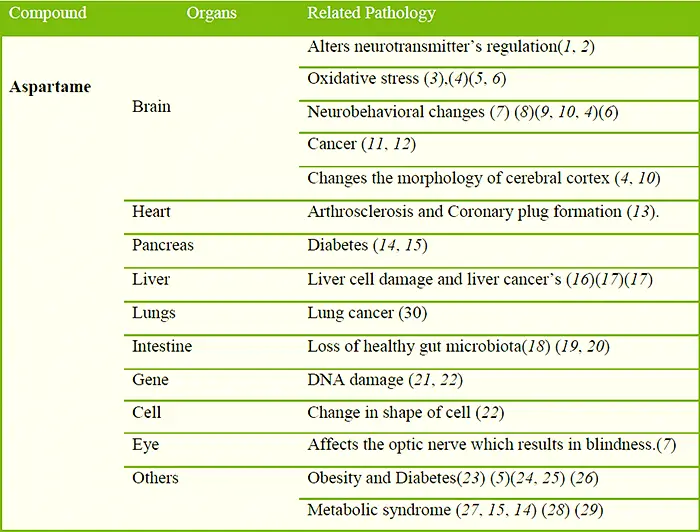
Consommer ce produit pendant une période prolongée peut avoir des effets encore plus graves. Surtout chez les enfants et les femmes enceintes. Le problème est qu'aujourd'hui l'aspartame et d'autres excitotoxines sont ajoutés partout. Il n'y a aucune possibilité réelle que quelqu'un qui mange quoi que ce soit préparé par le industrie alimentaire serait en mesure d'éviter de les manger. Et ces produits chimiques ne sont que la pointe de l'iceberg.
Références :
- Rycerz, K., & Jaworska-Adamu, JE (2013). Effets des métabolites de l'aspartame sur les astrocytes et les neurones. Feuille neuropathologique, 51(1), 10–17. https://doi.org/10.5114/fn.2013.34191
- Humphries, P., Pretorius, E., & Naudé, H. (2008). Effets cellulaires directs et indirects de l'aspartame sur le cerveau. European journal of clinical nutrition, 62(4), 451–462. https://doi.org/10.1038/sj.ejcn.1602866
- Ashok, I., Sheeladevi, R. et Wankhar, D. (2015). Effet aigu du stress oxydatif induit par l'aspartame dans le cerveau du rat albinos Wistar. Revue de recherche biomédicale, 29(5), 390–396. https://doi.org/10.7555/JBR.28.20120118
- Onaolapo, AY, Abdusalam, SZ et Onaolapo, JO (2017). La silymarine atténue les variations induites par l'aspartame dans le comportement de la souris, la morphologie cérébrocorticale et les marqueurs de stress oxydatif. Physiopathologie : la revue officielle de la Société internationale de physiopathologie, 24(2), 51–62. https://doi.org/10.1016/j.pathophys.2017.01.002
- Choudhary AK (2018). Aspartame : les personnes atteintes de diabète de type II devraient-elles en prendre ?. Revues actuelles sur le diabète, 14(4), 350–362. https://doi.org/10.2174/1573399813666170601093336
- Choudhary, AK, & Lee, YY (2018). Symptômes neurophysiologiques et aspartame : quel est le lien ?. Neurosciences nutritionnelles, 21(5), 306–316. https://doi.org/10.1080/1028415X.2017.1288340
- González-Quevedo, A., Obregón, F., Urbina, M., Roussó, T. et Lima, L. (2002). Effet de l'administration chronique de méthanol sur les acides aminés et les monoamines dans la rétine, le nerf optique et le cerveau du rat. Toxicologie et pharmacologie appliquée, 185(2), 77–84. https://doi.org/10.1006/taap.2002.9477
- Lindseth, GN, Coolahan, SE, Petros, TV et Lindseth, PD (2014). Effets neurocomportementaux de la consommation d'aspartame. Recherche en soins infirmiers et en santé, 37(3), 185–193. https://doi.org/10.1002/nur.21595
- Guo, X., Park, Y., Freedman, ND, Sinha, R., Hollenbeck, AR, Blair, A. et Chen, H. (2014). Les boissons sucrées, le café et le thé et le risque de dépression chez les adultes américains âgés. PloS un, 9(4), e94715. https://doi.org/10.1371/journal.pone.0094715
- Onaolapo, AY, Onaolapo, JO et Nwoha, PU (2016). Altérations du comportement, de la morphologie corticale cérébrale et des marqueurs cérébraux du stress oxydatif suite à l'ingestion d'aspartame. Journal de neuroanatomie chimique, 78, 42–56. https://doi.org/10.1016/j.jchemneu.2016.08.006
- Olney, JW, Farber, NB, Spitznagel, E., & Robins, LN (1996). Augmentation des taux de tumeurs cérébrales : y a-t-il un lien avec l'aspartame ?. Journal de neuropathologie et de neurologie expérimentale, 55(11), 1115–1123. https://doi.org/10.1097/00005072-199611000-00002
- En ligneHuff, J., & LaDou, J. (2007). Les résultats des essais biologiques sur l'aspartame laissent présager des risques de cancer chez l'homme. Revue internationale de santé au travail et environnementale, 13(4), 446–448. https://doi.org/10.1179/oeh.2007.13.4.446
- Hall, LN, Sanchez, LR, Hubbard, J., Lee, H., Looby, SE, Srinivasa, S., Zanni, MV, Stanley, TL, Lo, J., Grinspoon, SK et Fitch, KV (2017 ). L'apport d'aspartame est lié à la charge de plaque coronarienne et aux indices inflammatoires du virus de l'immunodéficience humaine. Forum ouvert sur les maladies infectieuses, 4(2), ofx083. https://doi.org/10.1093/ofid/ofx083
- Palmer, JR, Boggs, DA, Krishnan, S., Hu, FB, Singer, M. et Rosenberg, L. (2008). Boissons sucrées et incidence du diabète sucré de type 2 chez les femmes afro-américaines. Archives of internal medicine, 168(14), 1487–1492. https://doi.org/10.1001/archinte.168.14.1487
- Malik, VS, Popkin, BM, Bray, GA, Després, JP, Willett, WC, & Hu, FB (2010). Boissons sucrées et risque de syndrome métabolique et de diabète de type 2 : une méta-analyse. Traitements diabétiques, 33(11), 2477-2483. https://doi.org/10.2337/dc10-1079
- Finamor, I., Perez, S., Bressan, CA, Brenner, CE, Rius-Perez, S., Brittes, PC, Cheiran, G., Rocha, MI, da Veiga, M., Sastre, J., & Pavanato, MA (2017). La consommation chronique d'aspartame provoque des modifications de la voie de trans-sulfuration, une déplétion en glutathion et des lésions hépatiques chez la souris. Redox biology, 11, 701–707. https://doi.org/10.1016/j.redox.2017.01.019
- Soffritti, M., Belpoggi, F., Manservigi, M., Tibaldi, E., Lauriola, M., Falcioni, L. et Bua, L. (2010). L'aspartame administré dans l'alimentation, de la période prénatale à la durée de vie, induit des cancers du foie et du poumon chez les souris Swiss mâles. Revue américaine de médecine industrielle, 53(12), 1197-1206. https://doi.org/10.1002/ajim.20896
- Nettleton, JE, Reimer, RA et Shearer, J. (2016). Remodeler le microbiote intestinal : impact des édulcorants hypocaloriques et lien avec la résistance à l'insuline ?. Physiologie & comportement, 164(Pt B), 488–493. https://doi.org/10.1016/j.physbeh.2016.04.029
- Palmnäs, MS, Cowan, TE, Bomhof, MR, Su, J., Reimer, RA, Vogel, HJ, Hittel, DS et Shearer, J. (2014). La consommation d'aspartame à faible dose affecte différemment les interactions métaboliques entre le microbiote intestinal et l'hôte chez le rat obèse induit par l'alimentation. PloS un, 9(10), e109841. https://doi.org/10.1371/journal.pone.0109841
- Suez , J. , Korem , T. , Zeevi , D. , Zilberman-Schapira , G. , Thaiss , CA , Maza , O. , Israel , D. , Zmora , N. , Gilad , S. , Weinberger , A . , Kuperman , Y. , Harmelin , A. , Kolodkin-Gal , I. , Shapiro , H. , Halpern , Z. , Segal , E. , & Elinav , E. ( 2014 ). Les édulcorants artificiels induisent une intolérance au glucose en altérant le microbiote intestinal. Nature, 514(7521), 181–186. https://doi.org/10.1038/nature13793
- Bandyopadhyay, A., Ghoshal, S. et Mukherjee, A. (2008). Test de génotoxicité des édulcorants hypocaloriques : aspartame, acésulfame-K et saccharine. Toxicologie des médicaments et des produits chimiques, 31(4), 447–457. https://doi.org/10.1080/01480540802390270
- van Eyk AD (2015). L'effet de cinq édulcorants artificiels sur les cellules Caco-2, HT-29 et HEK-293. Toxicologie des médicaments et des produits chimiques, 38(3), 318–327. https://doi.org/10.3109/01480545.2014.966381
- Brown, RJ, de Banate, MA, & Rother, KI (2010). Édulcorants artificiels : une revue systématique des effets métaboliques chez les jeunes. Journal international de l'obésité pédiatrique : IJPO : un journal officiel de l'Association internationale pour l'étude de l'obésité, 5(4), 305–312. https://doi.org/10.3109/17477160903497027
- Bhupathiraju, SN, Pan, A., Malik, VS, Manson, JE, Willett, WC, van Dam, RM et Hu, FB (2013). Boissons caféinées et sans caféine et risque de diabète de type 2. La revue américaine de nutrition clinique, 97(1), 155–166. https://doi.org/10.3945/ajcn.112.048603
- de Koning, L., Malik, VS, Rimm, EB, Willett, WC et Hu, FB (2011). Consommation de boissons sucrées et artificiellement sucrées et risque de diabète de type 2 chez les hommes. La revue américaine de nutrition clinique, 93(6), 1321-1327. https://doi.org/10.3945/ajcn.110.007922
- Azad, MB, Abou-Setta, AM, Chauhan, BF, Rabbani, R., Lys, J., Copstein, L., Mann, A., Jeyaraman, MM, Reid, AE, Fiander, M., MacKay, DS , McGavock, J., Wicklow, B., & Zarychanski, R. (2017). Édulcorants non nutritifs et santé cardiométabolique : une revue systématique et une méta-analyse d'essais contrôlés randomisés et d'études de cohorte prospectives. CMAJ : Canadian Medical Association journal = journal de l’Association medicale canadienne, 189(28), E929–E939. https://doi.org/10.1503/cmaj.161390
- Ferreira-Pêgo, C., Babio, N., Bes-Rastrollo, M., Corella, D., Estruch, R., Ros, E., Fitó, M., Serra-Majem, L., Arós, F. , Fiol, M., Santos-Lozano, JM, Muñoz-Bravo, C., Pintó, X., Ruiz-Canela, M., Salas-Salvadó, J., & PREDIMED Investigators (2016). La consommation fréquente de boissons sucrées et artificiellement sucrées et de jus de fruits naturels et en bouteille est associée à un risque accru de syndrome métabolique dans une population méditerranéenne à haut risque de maladie cardiovasculaire. The Journal of nutrition, 146(8), 1528-1536. https://doi.org/10.3945/jn.116.230367
- Pepino MY (2015). Effets métaboliques des édulcorants non nutritifs. Physiologie & comportement, 152(Pt B), 450–455. https://doi.org/10.1016/j.physbeh.2015.06.024
- Daly, K., Darby, AC et Shirazi-Beechey, SP (2016). Édulcorants hypocaloriques et microbiote intestinal. Physiologie & comportement, 164(Pt B), 494–500. https://doi.org/10.1016/j.physbeh.2016.03.014
- Mosmann T. (1983). Test colorimétrique rapide de la croissance et de la survie cellulaire : application aux tests de prolifération et de cytotoxicité. Journal des méthodes immunologiques, 65(1-2), 55–63. https://doi.org/10.1016/0022-1759(83)90303-4
- Mao, L., Guo, M., Jin, D., Xue, B. et Wang, JQ (2013). Récepteurs métabotropiques du glutamate du groupe III et toxicomanie. Frontières de la médecine, 7(4), 445–451. https://doi.org/10.1007/s11684-013-0291-1
- Walton, RG, Hudak, R., & Green-Waite, RJ (1993). Effets indésirables de l'aspartame : challenge en double aveugle chez des patients issus d'une population vulnérable. Psychiatrie biologique, 34(1-2), 13–17. https://doi.org/10.1016/0006-3223(93)90251-8
- Lindseth, GN, Coolahan, SE, Petros, TV et Lindseth, PD (2014). Effets neurocomportementaux de la consommation d'aspartame. Recherche en soins infirmiers et en santé, 37(3), 185–193. https://doi.org/10.1002/nur.21595
Articles Similaires







Vous avez des questions sur la nutrition et la santé ?
Je serais ravie d'entendre vos commentaires et d'y répondre dans mon prochain message. J'apprécie votre contribution et votre opinion et j'espère avoir bientôt de vos nouvelles. Je vous invite également à nous suivre sur Facebook, Instagram et Pinterest pour plus de contenu sur l'alimentation, la nutrition et la santé. Vous pouvez y laisser un commentaire et entrer en contact avec d'autres passionnés de santé, partager vos conseils et expériences, et obtenir le soutien et les encouragements de notre équipe et de notre communauté.
J'espère que ce billet a été instructif et agréable pour vous et que vous êtes prêt à mettre en pratique les connaissances que vous avez acquises. Si vous avez trouvé ce billet utile, veuillez le partager à vos amis et à votre famille qui pourraient également en bénéficier. On ne sait jamais qui peut avoir besoin de conseils et de soutien dans son parcours de santé.
– Vous pourriez aussi aimer –
L'eau Distillée à Boire - Aide à la Désintoxication ou Poison Mortel ?
Causes du Diabète et Glucides Raffinés- L'argument Végétalien
Lait et Produits Laitiers : Corrélations Avec les Risques Pour la Santé

Épuisement du Glycogène - Comment ne Pas Faire d'Exercice

Régime Méditerranéen- "Merveille" de l'huile d'Olive

Exercice- Pourquoi en Avons Nous Exactement Besoin?

Consommation Optimale d'Antioxydants : Apports Recommandés en Unités ORAC
Carence en Vitamine D : Les Stratégies d'Optimisation

Apprendre la Nutrition

Milos Pokimica est docteur en médecine naturelle, nutritionniste clinique, rédacteur en santé médicale et nutrition et conseiller en sciences nutritionnelles. Auteur de la série de livres Devenir vegetarien ? Examen des sciences, il exploite également le site Web de santé naturelle GoVeganWay.com
Avis de non-responsabilité médicale
GoVeganWay.com vous propose des critiques des dernières recherches liées à la nutrition et à la santé. Les informations fournies représentent l'opinion personnelle de l'auteur et ne sont pas destinées ni implicites à se substituer à un avis médical professionnel, un diagnostic ou un traitement. Les informations fournies sont à titre informatif uniquement et ne sont pas destinées à remplacer la consultation, le diagnostic et/ou le traitement médical d'un médecin qualifié ou d'un prestataire de soins de santé.NE JAMAIS IGNORER LES CONSEILS MÉDICAUX PROFESSIONNELS OU RETARDER LA RECHERCHE DE SOINS MÉDICAUX EN RAISON DE QUELQUE CHOSE QUE VOUS AVEZ LU OU ACCÉDÉ SUR GoVeganWay.com
N'APPLIQUEZ JAMAIS DE CHANGEMENTS AU STYLE DE VIE OU TOUT CHANGEMENT À LA SUITE DE QUELQUE CHOSE QUE VOUS AVEZ LU SUR GoVeganWay.com AVANT DE CONSULTER UN PRATICIEN MÉDICAL AGRÉÉ.
En cas d'urgence médicale, appelez immédiatement un médecin ou le 911. GoVeganWay.com ne recommande ni n'approuve aucun groupe, organisation, test, médecin, produit, procédure, opinion ou autre information spécifique pouvant être mentionné à l'intérieur.
Choix de l'éditeur -

Cancer Choix de l'éditeur Phytochimiques
Pouvoir Anticancéreux des Fruits et Légumes : Preuves in Vivo et Cliniques
Certains extraits végétaux rivalisent avec les principaux médicaments de chimiothérapie et ciblent en même temps plusieurs types différents de cellules cancéreuses.
Antioxydants Choix de l'éditeur ORAC
Les Huiles Essentielles en Tant Que Compléments Antioxydants : Règles et Stratégies
Les huiles essentielles de qualité alimentaire peuvent constituer une stratégie pratique et conviviale pour optimiser la valeur antioxydante et les scores ORAC de notre alimentation.
Antioxydants Choix de l'éditeur ORAC
Régime Riche en Antioxydants : Règles Rénérales et Stratégies
Il existe des stratégies simples et rentables pour optimiser la valeur antioxydante de notre alimentation.
Antioxydants Choix de l'éditeur ORAC
Comprendre les Valeurs ORAC : La Teneur en Antioxydants des Aliments
Lorsque votre principale source d'antioxydants est le café, vous savez que vous avez un sérieux problème.

Antioxydants Choix de l'éditeur ORAC
Avantages de l’Astaxanthine : L’Antioxydant Naturel le Plus Puissant au Monde
L'astaxanthine est l'antioxydant naturel et universel le plus puissant (soluble dans l'huile et dans l'eau) connu de la science. Il s'accumule dans les tissus et ne peut jamais se transformer en pro-oxydant.

Antioxydants Choix de l'éditeur ORAC Phytochimiques
Les Antioxydants : Comprendre les Bases
Il n'y a pas de composés phytochimiques ou d'antioxydants dans les produits d'origine animale. En moyenne, les aliments végétaux contiennent plus de 60 fois plus d'antioxydants que les aliments d'origine animale.
Choix de l'éditeur Régime végétalien
Les Carences en Nutriments Dans le Régime Végétalien : Stratégies de Prévention
Il existe neuf carences nutritionnelles courantes à l'échelle de la population qui affectent les personnes qui suivent un régime à base de plantes. Si elles ne sont pas corrigées à temps, certaines déficiences ont des conséquences terribles et incurables.
Choix de l'éditeur Régime optimal
Déficience en Micronutriments Dans le Régime Alimentaire Américain Standard : Stratégies d'Optimisation
Le profil nutritionnel de notre régime moderne à base de viande, de sucre et d'aliments transformés est totalement incongru avec notre évolution, ce qui entraîne de graves carences en micronutriments.
Choix de l'éditeur Phytochimiques
Photochimie : Comprendre les Bases
Chaque phytochimique qui existe a une action biologique dans le corps humain. Chacun parmi des millions de composés phytochimiques différents.
Choix de l'éditeur Lait Régime optimal
Lait et Produits Laitiers : Corrélations Avec les Risques Pour la Santé
Les associations connues avec le lait et la consommation de produits laitiers sont l'infertilité, le cancer de l'ovaire et du sein, la leucémie, le diabète de type 1, l'autisme, l'artériosclérose, la cataracte, la polyarthrite rhumatoïde, la sclérose en plaques, l'hyperactivité, la congestion, les boutons, etc.
Cancer Choix de l'éditeur Protéine
Protéine Complète : Signalisation de l'IGF-1 dans la Formation du Cancer
Lorsque vous mangez des protéines animales, vous avez quatre fois plus de chances de développer tous les types de cancer. Lorsque vous fumez, vous avez quatre fois plus de chances de développer un cancer du poumon.

Cancer Choix de l'éditeur Protéine
Anatomie du Cancer - Corrélations Entre Les Risques Pour la Santé
Environ 2 % des cancers sont considérés par la médecine comme purement causés par des facteurs génétiques. La même gamme que dans le règne animal. On ne vous a pas dit toute la vérité.
Milos Pokimica est rédacteur spécialisé dans la santé et la nutrition et conseiller en sciences nutritionnelles. Auteur d'une série de livres Devenir vegetarien ? Examen des sciences, il exploite également le site Web de santé naturelle GoVeganWay.com
Derniers Articles –

Restriction calorique Longévité
Comment Jeûner : Les Aliments de Jeûne Qui N'interrompent Pas L'Autophagie
L'autophagie. Vous êtes-vous déjà demandé ce qu'il advient des cellules de votre corps lorsqu'elles meurent ou sont endommagées ? S'accumulent-elles et créent-elles des problèmes, ou sont-elles éliminées d'une manière ou d'une autre ? La réponse est que votre corps...

Santé Dentaire La prévention
Sensibilité et Douleur des Dents aux Sucreries : Solution Rapide et Durable
L'huile essentielle de clou de girofle est une solution rapide et facile pour soulager la douleur. C'est un antioxydant puissant et un analgésique qui peut aider à lutter contre les maladies des gencives et les maux de dents.

Les haricots
Haricots Verts : Nutrition et Bienfaits Pour La Santé
Les haricots verts sont pauvres en calories et riches en composés naturels qui peuvent vous aider à contrôler votre glycémie, à réduire votre taux de cholestérol et à lutter contre les radicaux libres.
Régime alimentaire cru Régime végétalien
Peut-on Manger des Champignons Crus : Risques pour la Santé, Nutrition et Sécurité
Les champignons contiennent des toxines sensibles à la chaleur, comme l'hydrazine ou l'agaritine, et des parois cellulaires composées de chitine qui ne peuvent pas être digérées correctement par l'homme.

Régime végétalien
Les Poissons Sont-ils Des Animaux ? Une Perspective Culturelle
Dans certaines cultures, la viande de poisson n'est pas considérée comme de la viande et le poisson est autorisé même pendant le jeûne.

Santé Dentaire La prévention
Rince-bouche Naturel Fait Maison : Éprouvé, Plus Fort et Moins Toxique
Le bain de bouche naturel fait maison est plus puissant que la chlorhexidine, moins toxique et, s'il est avalé, il peut donner des nausées, mais il a aussi une valeur ORAC élevée.
Santé Dentaire La prévention
Comment Arrêter les Caries Dentaires : Symptômes, Causes et Prévention
La consommation de sucre est la principale cause des caries dentaires, associée à des carences en minéraux, notamment en magnésium, zinc, cuivre et oligo-éléments.
Antioxydants Superaliments
Amla : Avantages Prouvés, Nutrition et Signification Clinique
L'amla est l'un des antioxydants les plus puissants au monde, avec un score ORAC de 261 530. Il s'agit d'une riche source de substances phytochimiques qui ont de nombreux effets bénéfiques sur la santé.
Top Des Nouvelles Sur la Santé - ScienceDaily
- Glucosamine, a popular joint supplement, linked to faster Alzheimer’s progressionle septembre 27, 2026
A large health-record analysis found that glucosamine use was associated with a 25% higher likelihood of mild cognitive impairment progressing to dementia. Lab experiments suggest the popular joint supplement may intensify an abnormal sugar-tagging process in the Alzheimer’s brain, although researchers say clinical trials are needed to determine whether it actually causes harm.
- Atrial fibrillation patients saw 69% lower risk with common blood thinnersle septembre 27, 2026
Direct oral anticoagulants cut the risk of serious clinical events by 69% in atrial fibrillation patients with an intermediate risk of stroke, according to the randomized SINGLE-AF trial. The benefit was driven mainly by fewer ischemic strokes, with no increase in major bleeding.
- One CRISPR treatment cut “bad” cholesterol in half for a full yearle septembre 27, 2026
A single dose of an experimental CRISPR therapy cut LDL cholesterol and triglycerides by about half in patients with difficult-to-treat lipid disorders. The reductions were still present one year later, with the highest dose lowering LDL by 52.5% and triglycerides by 47.8%.
- Why rheumatoid arthritis pain may persist even when inflammation is under controlle septembre 27, 2026
Pain and fatigue in rheumatoid arthritis can persist even after inflammation improves, with depression, poor sleep, obesity, smoking, and chronic pain potentially helping sustain symptoms. Researchers say identifying these hidden drivers could prevent unnecessary medication changes and lead to more personalized treatment.
- Scientists say house cats could help unlock better cancer treatments for humansle septembre 27, 2026
Scientists have mapped the genetics of cat cancer on an unprecedented scale and found surprising similarities with tumors in humans. The findings could help bring precision cancer treatments to cats while also revealing new clues about how human cancers develop and respond to drugs.
- A major risk of breast cancer screening may have been overestimated for decadesle septembre 26, 2026
A new analysis suggests mammograms may lead to far less breast cancer overdiagnosis than some earlier studies indicated. Researchers reexamined all eight major randomized screening trials and accounted for differences in follow-up time, screening frequency, and screening after trials ended. Their results were consistent with an overdiagnosis rate below 5%, rather than estimates approaching 30% to 50%.
- That fresh cleaning smell could be filling your home with nanoparticlesle septembre 26, 2026
Researchers found that scented cleaners can react with ozone indoors to create billions or trillions of invisible nanoparticles that can penetrate deep into the lungs. The pollution forms within minutes and, in some cases, may produce an inhaled particle dose comparable to or greater than standing near heavy traffic.
PubMed, #régime-vegan –
- Plant-Based Diets in Adolescence: Cardiometabolic Benefits, Developmental Risks, and the Role of Fortificationle septembre 26, 2026
Adolescence is a critical window in which dietary patterns stabilise while nutrient requirements remain high to support growth, bone accrual, and neurodevelopment. Plant-based diets are increasingly adopted by young people, yet paediatric evidence indicates that they should not be treated as a single exposure, because diet quality substantially modifies both benefits and risks. Healthy plant-based patterns-rich in whole grains, legumes, fruits, vegetables, nuts, and unsaturated fats-are…
- Plant-Based Functional Custard Enriched with Vitamin D3: Insight into Technological Properties, Nutrition and Bone Tissue Regenerationle septembre 26, 2026
A plant-based or vegan diet is considered one of the most important dietary patterns, often followed for religious or health reasons. It should contain vital nutrients such as protein, iron, zinc, calcium, vitamin D, and others. The objective of this study was to produce a plant-based food product with high nutritional value (vegan custard, VC) and fortify it with vitamin D(3) (vegan custard + D(3)). Thirty-five female albino rats, with an average body weight of 160 ± 5 g, were divided […]
- Dietary Patterns, Micronutrient Adequacy, and Metabolic Vulnerability in Alzheimer’s Disease: A Critical Narrative Reviewle septembre 26, 2026
Dietary factors may influence cognitive aging and Alzheimer’s disease (AD), but observational associations, mechanistic findings, and intervention effects should not be considered equivalent evidence. This critical narrative review examines how dietary patterns, micronutrient adequacy, and metabolic health may modify AD-related vulnerability. A targeted search of PubMed/MEDLINE, Scopus, and Web of Science through April 2026 prioritized systematic reviews, meta-analyses, randomized trials, and…
- A Structured Narrative Review of Contemporary Dietary Strategies Following Acute Coronary Syndromesle septembre 24, 2026
CONCLUSIONS: A Mediterranean-style diet remains the dietary pattern supported by the strongest evidence for secondary prevention following ACS. Until further pragmatic randomized trials are available, clinicians should continue recommending Mediterranean-style dietary patterns while individualising dietary advice according to patient preferences, cultural practices, and long-term adherence.
- Toward International Dietary Guidance: A Food Guide Pyramid for Human and Planetary Healthle septembre 23, 2026
Dietary guidelines shape food policy, education, and food systems worldwide. Recent controversies in dietary guideline development, together with rising burdens of diet-related chronic disease and increasing environmental pressures, highlight the need for globally relevant dietary guidance aligned with both human and planetary health. We developed an evidence-informed International Food Guide Pyramid emphasizing optimal carbohydrate-containing staple foods. The International Carbohydrate […]
Messages Aléatoires -
Cancer
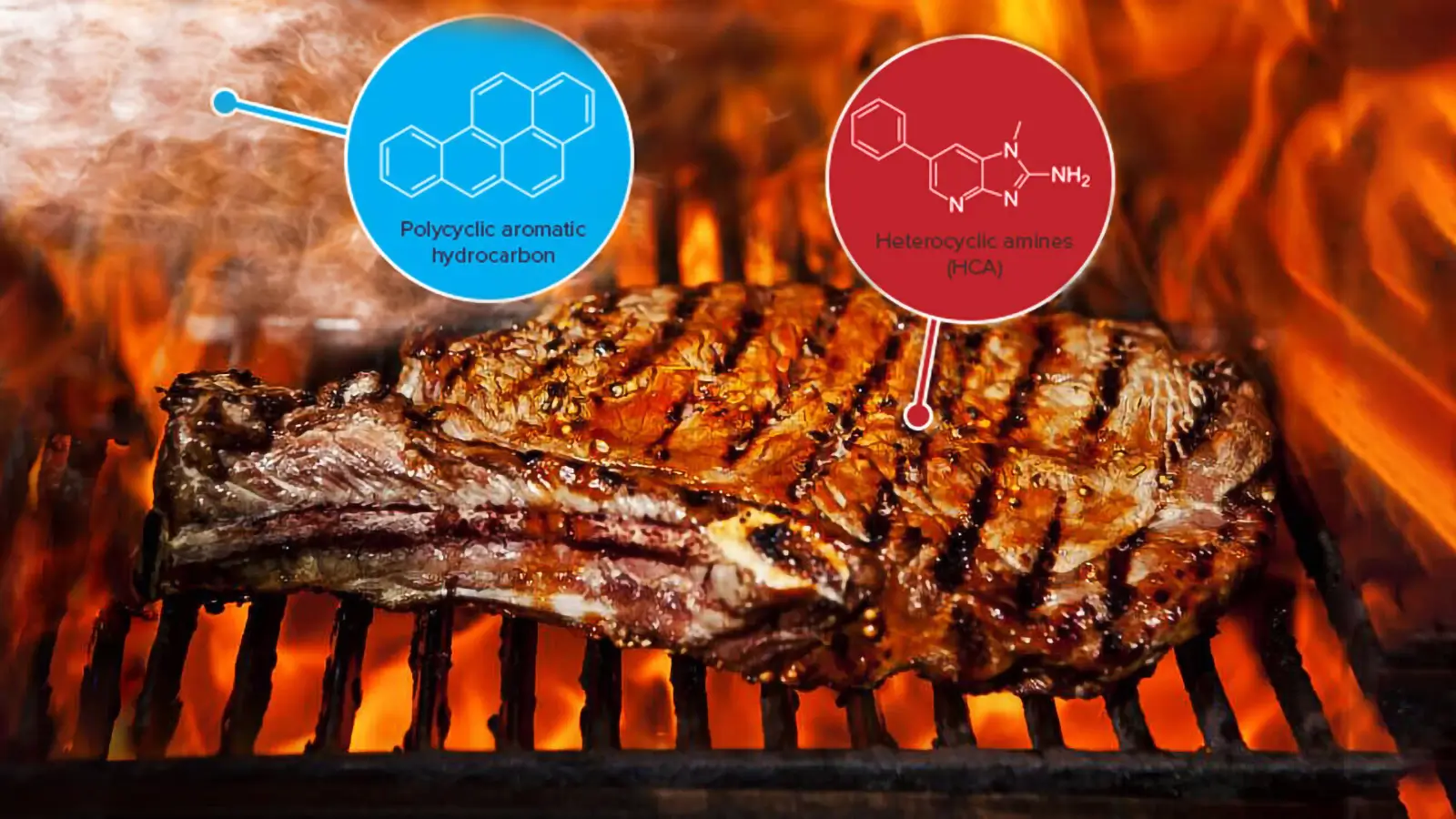
Viande Cuite- Le Mutagène Dans Une Bouchée, Exposition Aux Amines Hétérocycliques
Le chauffage des acides aminés en présence de créatine (viande cuite) crée des mutagènes connus sous le nom d'amines hétérocycliques (HCA).

Désintoxication Toxicité
Désintoxication - Une Revue Scientifique
Il existe des programmes de régime conçus pour aider à réduire l'inflammation et la toxicité globale du corps et à augmenter la désintoxication qui sont soutenus par la science.

Activité physique La prévention
Exercice- Pourquoi en Avons Nous Exactement Besoin?
Dans la communauté de la santé, l'exercice a un statut presque mythique comme l'une des meilleures choses que vous puissiez faire pour vous-même, à l'exception de l'évitement de fumer.

Cancer Inflammation Toxicité
Toxicité du Poisson - La Viande la Plus Toxique
La pollution est emportée et finira par se retrouver dans l'océan et les algues filtrent l'eau en déclenchant le processus de bioaccumulation. La toxicité des poissons est une grande préoccupation.

Antioxydants
Le Pouvoir Antioxydant de la Vitamine C : Améliorer la Santé et la Longévité
La vitamine C ne nécessite pas d'activité enzymatique pour être éliminée de l'organisme et ne devient pas pro-oxydant mais une forme réduite d'antioxydant plus faible.
Cancer Choix de l'éditeur Protéine
Protéine Complète : Signalisation de l'IGF-1 dans la Formation du Cancer
Lorsque vous mangez des protéines animales, vous avez quatre fois plus de chances de développer tous les types de cancer. Lorsque vous fumez, vous avez quatre fois plus de chances de développer un cancer du poumon.

Régime optimal La prévention Régime végétalien
Régime Méditerranéen- "Merveille" de l'huile d'Olive
Commercialisé comme une merveille d'huile d'olive, le régime méditerranéen n'a rien à voir avec une huile quelconque, sauf dans la mesure où elle peut remplacer le beurre et le saindoux.

Régime alimentaire cru
Alimentation Crue - La Perspective Evolutive
La croyance de base dans la communauté des aliments crus est qu'un régime alimentaire cru est le mode de vie le plus naturel et le plus sain. Que nous dit la biologie évolutive?

Inflammation Toxicité
Endotoxémie Bactérienne de la Viande Cuite- Inflammation et Alimentation
Les humains sont-ils omnivores au sens propre de l'anatomie ? Il existe une différence fondamentale dans le fonctionnement du tube digestif entre les plantes et les espèces carnivores.

La sclérose latérale amyotrophique La prévention Toxicité
Sclérose Latérale Amyotrophique - Floraison d'Algues Cyanobactériennes et Exposition Alimentaire aux BMAA
Une abondance de nutriments dans les zones côtières créée par le ruissellement rempli d'engrais synthétiques provenant des terres agricoles entraîne une prolifération excessive d'algues. Les proliférations d'algues sont dangereuses. Les microalgues créent et excrètent certaines des neurotoxines les plus puissantes connues de l'homme.

Postes en Vedette -

Choix de l'éditeur Régime optimal Régime végétalien
Directives Diététiques de l'OMS - Nouvelle Pyramide Alimentaire et Suppression de la Science
Les directives diététiques de l'OMS recommandent une alimentation pauvre en graisses saturées (protéines animales), en sucre et en sel et riche en fruits et légumes pour lutter contre l'augmentation épidémique des maladies chroniques dans le monde.
Antioxydants Choix de l'éditeur ORAC
Comprendre les Valeurs ORAC : La Teneur en Antioxydants des Aliments
Lorsque votre principale source d'antioxydants est le café, vous savez que vous avez un sérieux problème.
Diabète Choix de l'éditeur
Causes du Diabète et Glucides Raffinés- L'argument Végétalien
Les gens pensent que les glucides raffinés sont associés à des pics d'insuline et sont l'une des causes du diabète. Ils ont raison. Cependant, ils ont également tort.

Cancer Choix de l'éditeur Toxicité
Pesticides Dans les Aliments, Exposition Dans le Régime Alimentaire Américain Standard- 80 % de Viande
La plupart des pesticides et en particulier les métaux lourds et autres polluants toxiques que nous obtenons proviennent de la viande. Plus de 80 % de l'exposition aux pesticides dans le régime alimentaire américain standard provient de produits d'origine animale, et non de fruits ou de légumes.
Choix de l'éditeur Inflammation
Le Dilemme des Humains Omnivores- Consommation de Viande, Bactéries Probiotiques, Inflammation et Intestin
Les humains sont-ils omnivores au sens propre de l'anatomie ? Il existe une différence fondamentale dans le fonctionnement du tube digestif entre les plantes et les espèces carnivores.

Choix de l'éditeur Obésité
Hyperphagie Boulimique - La Psychologie de la Faim
Dans la nature, il n'y a ni sucre raffiné ni graisse. Notre cerveau n'avait jamais été exposé à une combinaison des deux tout à la fois nous forçant à l'hyperphagie boulimique.
Choix de l'éditeur La prévention Toxicité
Toxicité Environnementale- C'est Juste Une Chaîne Alimentaire
La toxicité environnementale est la bioaccumulation de toxines. Les organismes sont des filtres. Mais il existe un autre processus encore pire appelé bioamplification dans la chaîne alimentaire.

Choix de l'éditeur La prévention Régime végétalien
Étude sur la Chine- L'argument Végétalien
Une étude chinoise a montré qu'il n'y a pas de maladie cardiaque, de cancer ou de diabète dans les communautés rurales sous-développées du monde avec des régimes végétaliens à base d'amidon.

Choix de l'éditeur Régime optimal Protéine
Besoins en Protéines - Une Vérité Qui Dérange
Lorsque des études anthropologiques ont montré que les hominines vivaient en moyenne de 15 à 20 grammes de protéines par jour, il y a eu un soi-disant « grand fiasco des protéines » dans les années 1970.
Choix de l'éditeur Obésité
Expérience de Famine au Minnesota : Pourquoi les Régimes Nous Font Grossir. La Psychologie de la Faim.
L'une des premières études scientifiques sur les effets de la faim sur l'esprit a été observée dans une étude connue sous le nom de Minnesota Starvation Experiment réalisée par l'Université du Minnesota en 1944.
Dernières Nouvelles de PubMed, #alimentation végétale –
- Long-Term Monitoring of Radioactive Cesium in Commercial Foods and Dietary Intake Estimated by Total Diet Studies in Japan after the Fukushima Daiichi Nuclear Power Plant Accidentpar Hiromi Nabeshi le septembre 27, 2026
Following the Fukushima Daiichi Nuclear Power Plant accident in 2011, Japan implemented extensive monitoring of radioactive materials in foods and established strict regulatory limits based on an annual effective dose of 1 mSv/year from artificial radionuclides. This review summarizes long-term surveillance data on radioactive cesium (r-Cs) in commercial foods and long-term assessments of dietary intake of r-Cs and strontium-90 (^(90)Sr) using the total diet study (TDS)/market basket (MB)…
- Nutrition and Endometriosis: Current Evidence on Dietary Risk Factors and Clinical Impact – A Narrative Reviewpar Christine Dawczynski le septembre 27, 2026
Endometriosis (EM) is a severe chronic inflammatory disease characterized by the presence of endometrium-like tissue outside the uterine cavity, causing pain and significantly reducing quality of life. Worldwide, around 10% of women of reproductive age are affected and there is no cure as of now. The limited treatment options focus on hormone therapy, surgery and pain management–without satisfactory long-term effects. Nutritional strategies might support the prevention and treatment of…
- North American and Andean Indigenous Plant-Based Foods and Their Contemporary Scientific Rationale for Health Improvementpar Lena Gálvez Ranilla le septembre 27, 2026
Plant-based food systems have been an integral part of human ecology since the dawn of domestication across all continents from over 12,000 y ago. This served the needs of human health and wellness from whole plant form to the use of parts in a range of water-based extracts to dry form or fermentation-based applications. This conference paper focuses on some examples of plant-based foods in the Americas that have been used since ancient times among indigenous North American and Andean […]
- Plant-Based Diets in Adolescence: Cardiometabolic Benefits, Developmental Risks, and the Role of Fortificationpar Bianca Simionescu le septembre 26, 2026
Adolescence is a critical window in which dietary patterns stabilise while nutrient requirements remain high to support growth, bone accrual, and neurodevelopment. Plant-based diets are increasingly adopted by young people, yet paediatric evidence indicates that they should not be treated as a single exposure, because diet quality substantially modifies both benefits and risks. Healthy plant-based patterns-rich in whole grains, legumes, fruits, vegetables, nuts, and unsaturated fats-are…
- Dietary Patterns, Micronutrient Adequacy, and Metabolic Vulnerability in Alzheimer’s Disease: A Critical Narrative Reviewpar Isidora Sierralta le septembre 26, 2026
Dietary factors may influence cognitive aging and Alzheimer’s disease (AD), but observational associations, mechanistic findings, and intervention effects should not be considered equivalent evidence. This critical narrative review examines how dietary patterns, micronutrient adequacy, and metabolic health may modify AD-related vulnerability. A targeted search of PubMed/MEDLINE, Scopus, and Web of Science through April 2026 prioritized systematic reviews, meta-analyses, randomized trials, and…
- Baseline Ferritin and Body Composition as Correlates of Longitudinal Metabolic Changes During an Energy-Restricted Mediterranean-Style Intervention Across Three Overweight Phlogistic-Related Clinical…par Begoña de Cuevillas le septembre 26, 2026
CONCLUSIONS: Baseline ferritin and body composition were correlates of heterogeneous inflammatory-metabolic profiles and ferritin changes. These hypothesis-generating associations do not establish causal or mechanistic effects and require controlled confirmation with comprehensive iron-status assessment.